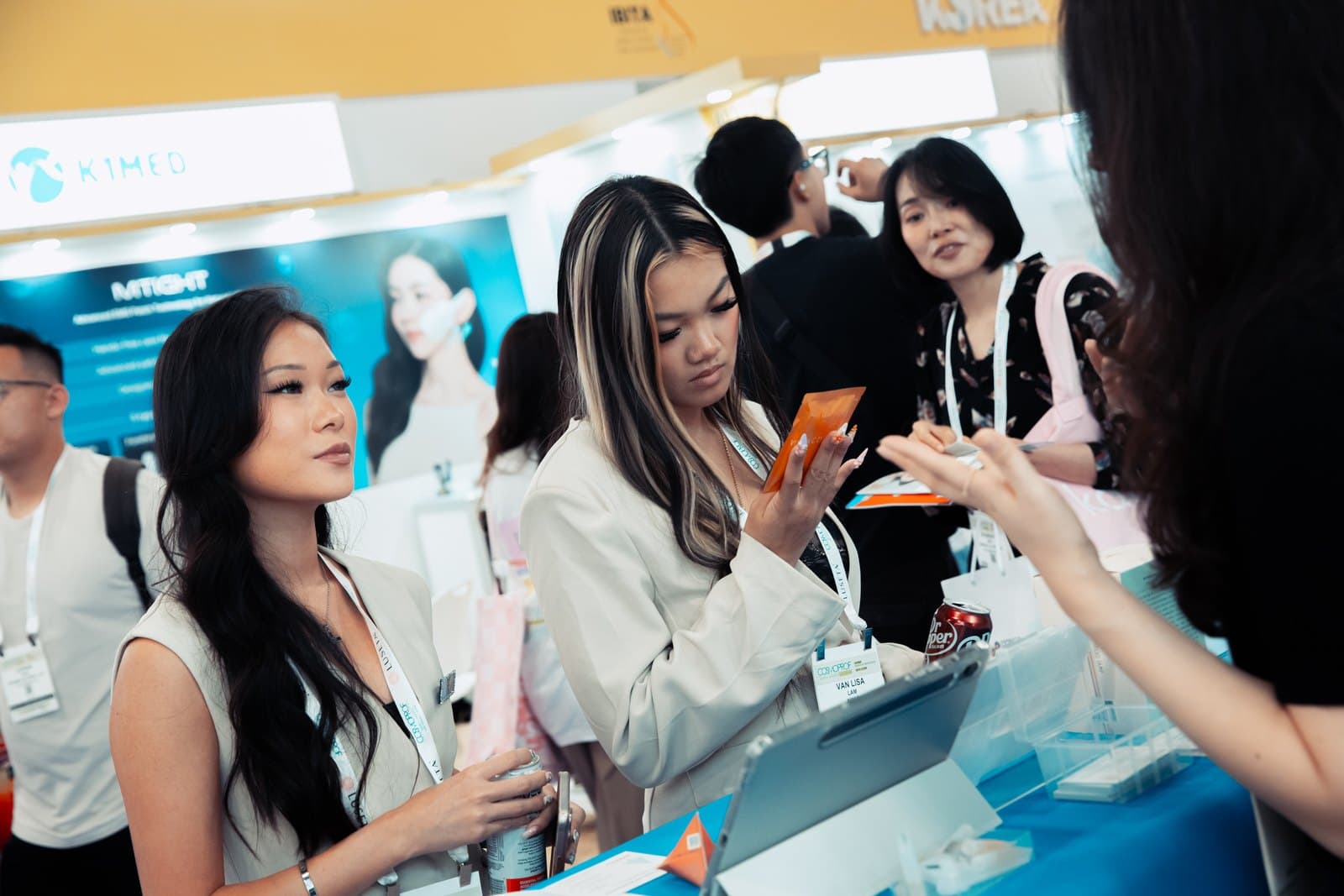
LAS VEGAS. The last of the five CosmoTrends directions selected at Cosmoprof North America was given the least serious name and covers the most serious change: Colla-Genius, cross-category collagen.
Two things are happening at once. Collagen is spreading out of skincare into makeup and body care, and the collagen itself is being replaced. The first is a merchandising story. The second is a supply chain story, and it is the one that will still matter in three years.
The report values the skincare collagen market at 7.4 billion dollars in 2025, heading to 11.8 billion by 2032 at a compound rate of 6.8 percent, citing Stats Market Research.

The ingredient changed underneath the claim
For decades, topical collagen meant hydrolyzed collagen from fish or bovine sources. It was large, it was inconsistent between batches, it carried an allergen and traceability burden, and it was disqualifying for a vegan positioning. Its main honest function on the skin was as a humectant, which is what Harper's Bazaar, quoted in the report, describes.
What arrived in Las Vegas is different. One of the serums in the showcase is built on a recombinant type III human-like collagen obtained by yeast fermentation, with a stated purity of not less than 99 percent. That is a biotech ingredient produced in a tank, not an animal by-product refined out of a food chain: consistent batch to batch, free of the allergen and traceability problem, and compatible with a vegan claim.
The report notes that in April, BASF launched a recombinant collagen III fragment that it says improved skin tonicity and the appearance of sagging and fine lines after four weeks of topical use. When an ingredient major commits to fermentation-derived collagen, the direction of the category is set, and the marine collagen supply chain becomes a legacy business.
Collagen boosters are the other half of the trade
Alongside actual collagen sits the argument that you should not apply it at all, but make the skin produce its own. Copper tripeptide-1, better known as GHK-Cu, appeared repeatedly across the floor, including in a pro-collagen serum from Pure & Cimple in the showcase. Dr. Dendy Engelman, quoted in the report from Porter, put the position bluntly: encouraging the skin to produce its own collagen, elastin and hyaluronic acid is now considered the gold standard for resilient skin that ages well.
That is a rare case of the marketing and the biology pointing the same way. It also, usefully for the industry, gives a second product to sell to the same consumer.
The cross-category part is the commercial news
The showcase deliberately spread the trend across categories, and that is the part a buyer should read closely.
mixsoon, from South Korea, brought a tinted moisturizer combining French collagen with rice PDRN and peptides, filed under make-up. Havyn, from the United States, a comforting collagen hand cream, filed under body. A Chinese exhibitor brought a Centella asiatica smoothing collagen mask. Another combined rice ferment with collagen across a facial and eye serum.
Skincare actives migrating into makeup and body care is how a beauty ingredient goes from trend to infrastructure. It also solves a real problem for brands: a hand cream or a tinted base is a far easier place to introduce an expensive active than a serum, because the consumer is not comparing it against the entire treatment aisle.
There is a caveat worth stating. Collagen in a hand cream is doing humectant work, not structural work, and the perimenopause and menopause conversation that the report attaches to the trend deserves better than a rinse-off claim. The brands that are careful about this will age better than the ones that are not.
What to watch
Watch the ingredient suppliers rather than the brands. If recombinant collagen keeps falling in price, the marine collagen story disappears within two product cycles and the vegan claim stops being a premium and becomes a default. Watch which retailers ask where the collagen came from, because that question is about to separate the brands that know their supply chain from the ones that bought a finished formula and a story to go with it.
Read our full report from the show: Cosmoprof North America 2026, where the beauty trade stopped paying for novelty.