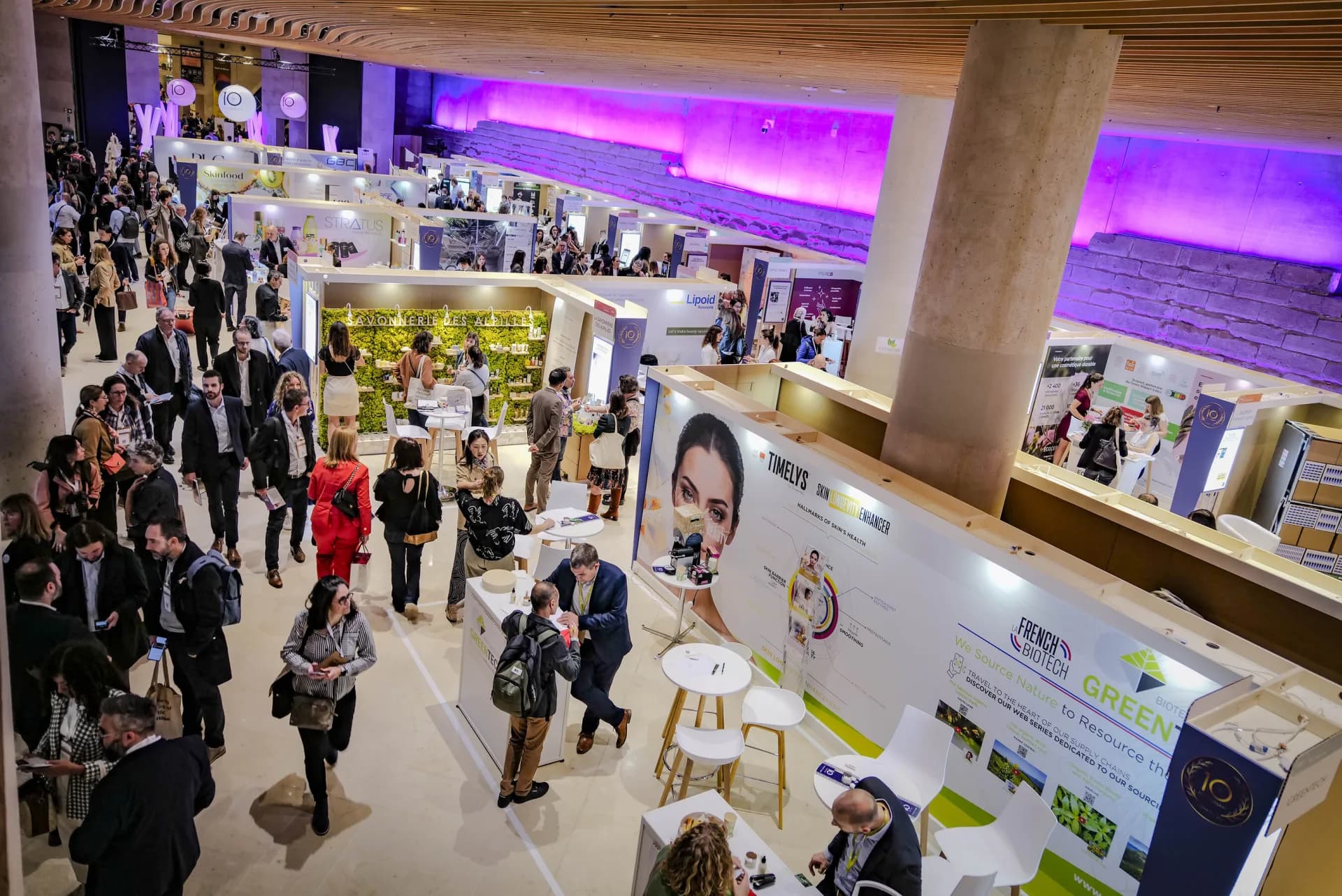
A week ago, before Cosmetic 360 opened at the Carrousel du Louvre, we set out what the show had promised and where we expected the promise to thin. The theme was Regenerations, and our question was simple: would the word arrive with a measurement attached, or only with a mood? We said the fastest summary would be the awards list, because it records what a jury of trade journalists believed after a day on the floor. The list is now out, and it answers the question better than we expected in one place and worse in others.
Seven winners, one theme prize
The Cosmetic 360 Awards were presented on Wednesday, October 14, and judged by an international jury drawn from twelve trade publications, as reported by Premium Beauty News. There are six categories and one special prize, the jury's favourite on the Regenerations theme. The winners come from Spain, South Korea, France, Taiwan and the Netherlands.
In raw materials, the Spanish biotech Vytrus won with Toleroxyl, a plant-produced human protein that the company says re-educates the immune response of urban skin. In formulation, Woorikids+ won with a platform that turns liquid cosmetics into anhydrous sheets without PVA. In testing and analysis, Complife Group won with a patented chamber that recreates temperature, humidity, pollution and light in the lab. In packaging, Replace won with a patented process, IPRA, that turns hard-to-recycle multilayer plastic packaging into fully recycled pallets and point-of-sale displays. In manufacturing, Biotech One won with Encapx, a nano-encapsulation technology using supercritical CO2. In brands and retail, the Taiwanese company Jubilee Biomedical won with Jubi Plasma, a cold plasma skincare device. And the Regenerations prize went to Primegreen, a Dutch supplier, for a licuri oil programme in Brazil. All of this as reported by Premium Beauty News.
The prize that earned the word
Start with the theme prize, because it is the one that was meant to define the edition.
Primegreen sources a lauric oil from the licuri palm, Syagrus coronata, in the caatinga, the dry scrubland of northeast Brazil, and the programme is designed to protect the food supply of the macaws that depend on the palm's seeds, as reported by Premium Beauty News. The bird in question is Lear's macaw. Its main food is licuri nuts, as many as 350 a day, and it lives in a small range south of the Raso da Catarina plateau in Bahia, where it remains listed as endangered, according to the species entry on Wikipedia drawing on the IUCN Red List.
This is the hard edge of regeneration that we hoped the show would put under the word. It is not a claim about what a cream does to a face. It is a claim about what buying an ingredient does to a place, and it has an object you can count: palms left standing, birds on a roost. Whether the programme delivers on that count is a question for its own reporting, and nothing in the award material we have read gives the numbers. But the jury chose a sourcing model over a molecule, and that is the right instinct. A regeneration claim that can be checked in the field is worth more to a retailer than ten that can only be checked in a lab report.
It also matters that the prize went to a supplier, not a brand. Biodiversity stories in beauty usually live in one brand's marketing, attached to one product. An ingredient supplier that builds the protection into the sourcing moves the story upstream, where any formulator can buy into it. That is how a claim becomes a standard.
Where the word got soft
Now the raw materials prize. Toleroxyl was launched by Vytrus at in-cosmetics Korea in July as the first of what the company calls tolerogens, an active meant to train hyperreactive skin rather than simply soothe it, as reported by Cosmetics Business. The mechanism is described in detail: a protein based on GM-CSF acting on the Langerhans cells of the skin. The clinical evidence, in the material published at launch, is described only as "visible benefits" in volunteers with hyperreactive skin, with no sample size or percentages given.
It is a serious piece of biotechnology, and Vytrus is a serious company. But it is also exactly the vocabulary we warned about a week ago. "Regenerate tolerance" is a phrase that will travel to a box in eighteen months, and when it does, a buyer will have to decide what it means. The award makes that decision harder, not easier.
The brands and retail prize is the weakest fit of the seven. Jubi Plasma is a home device that, by its maker's account, works below 40 degrees and delivers nine skincare benefits in 90 seconds, as reported by ICO Optics from the company's release. Nine benefits in a minute and a half is a marketing sentence, not a finding. Devices are a real retail category, and the clinical-claims arms race we tracked this year, from exosomes to PDRN, has made them more crowded. A category that carries the word "retail" in its name should reward something a retailer can explain at the counter. A count of benefits is not that.
The two prizes a store manager should notice
Two of the winners have nothing to do with skin and a great deal to do with shops.
Replace's process turns multilayer plastic, the laminated tubes and sachets that recycling streams reject, into pallets and point-of-sale displays, as reported by Premium Beauty News. That closes a loop inside retail itself. The display a brand puts on a beauty floor could be made from the packaging that brand already sold. It is the most practical idea on the list, and the one most likely to reach a store within a year.
Woorikids+ is the other. A cosmetic that ships as a dry sheet instead of a liquid in a bottle changes what sits on a shelf: lighter, smaller, no water, no plastic pump. Solid formats have been a niche for a decade. A formulation platform that makes them easier for any brand to produce is how a niche becomes an aisle.
What the list does not tell us
Three things remain open.
The first is attendance. The organizers announced 260 exhibitors and more than 5,800 expected visitors before the show. As of today, the official press page has published no closing figures, so we cannot say whether the edition beat last year's record or simply matched it.
The second is the Nutricosmetics Zone, the edition's big new feature. There was no award for it, and none of the winners is an ingestible. Our question from last week, where an ingestible beauty product is supposed to be sold, is still unanswered.
The third is proof. The conference programme promised a session called "Decoding regeneration: from ambition to proof". The jury, at least, picked the entry with the most visible proof. The rest of the industry now has a year to show its own, before the 13th edition on October 13 and 14, 2027, back at the Carrousel du Louvre, as announced by Premium Beauty News.
Sources: Premium Beauty News, "Cosmetic 360 Awards 2026 : Quelles sont les sept innovations récompensées ?", October 17, 2026; ICO Optics, "JUBI Plasma Wins Big at 2026 COSMETIC 360 Awards", October 19, 2026 (based on a release by Jubilee Biomedical); Cosmetics Business, "Vytrus launches Toleroxyl for urban skin at in-cosmetics Korea", July 2, 2026; Cosmetic 360, trade show press releases, consulted October 20, 2026; Wikipedia, "Lear's macaw", consulted October 20, 2026.