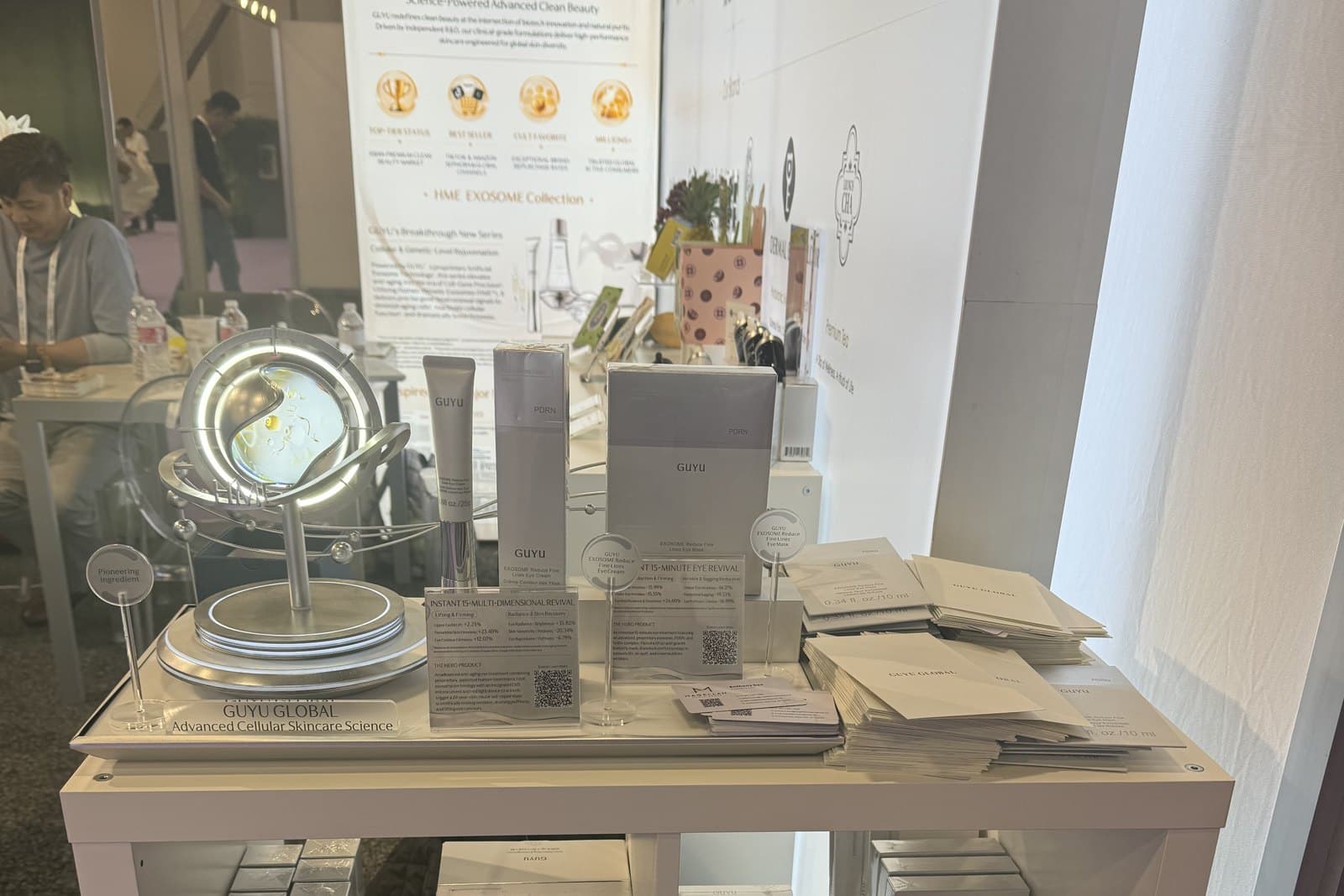
LAS VEGAS. The most revealing object on the Cosmoprof North America floor this year was not a product. It was a small acrylic card, about the size of a postcard, standing on a wire holder next to one.
They were everywhere. Not shelf talkers with adjectives on them, but claim tables: two columns, six lines, percentages to two decimal places, a footnote about the testing protocol and a QR code. The beauty industry has spent a decade borrowing the clinic's vocabulary. In Las Vegas it finished borrowing its layout.
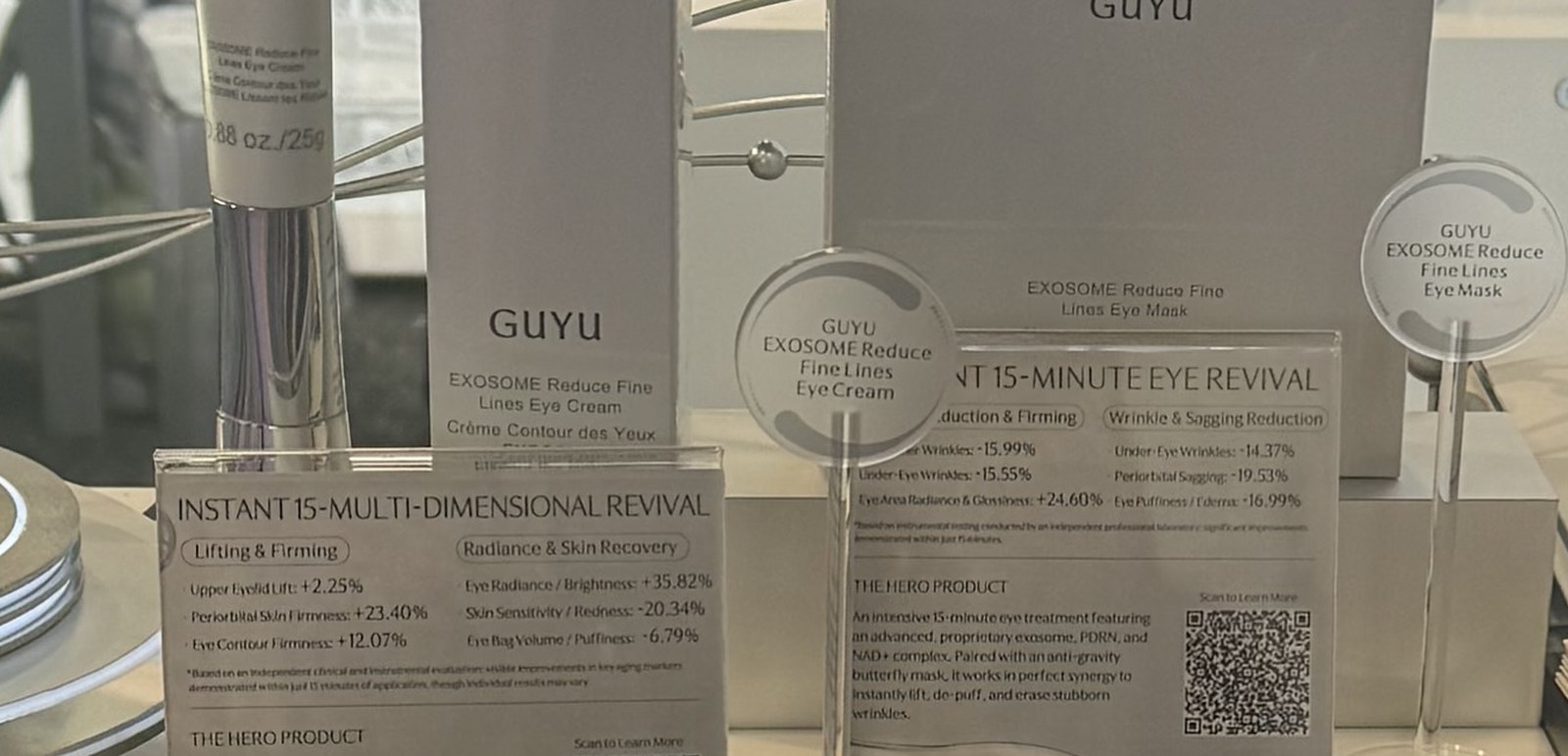
What a fifteen-minute claim looks like now
The card above belongs to an eye-care line built on what the exhibitor calls human-biomimetic exosome technology, paired with an EMS microcurrent and red light device. Its headline is instant 15 multi-dimensional revival, and the supporting table reads: eye radiance and brightness up 35.82 percent, periorbital skin firmness up 23.40 percent, eye contour firmness up 12.07 percent, skin sensitivity and redness down 20.34 percent, eye bag volume down 6.79 percent, upper eyelid lift up 2.25 percent. The footnote says the figures come from an independent clinical and instrumental evaluation, that the improvements were demonstrated within fifteen minutes of application, and that individual results may vary.
The companion card, for a mask in the same range, reports under-eye wrinkles down 15.55 percent, periorbital sagging down 19.53 percent, eye puffiness down 16.99 percent and eye area radiance up 24.60 percent, from an exosome, PDRN and NAD+ complex.
Note what that footnote does and does not say. It is careful, it is disclosed, and it is more transparent than most of what sits on a beauty shelf. It is also, read commercially, a fifteen-minute instrumental measurement being presented in the visual grammar of a clinical trial result.
The tell is the precision. An upper eyelid lift of 2.25 percent is reported with the same two decimal places and the same authority as a radiance gain of 35.82 percent. Decimals signal rigour. They do not supply it. A number reported to a hundredth of a percent on a fifteen-minute reading is telling you about the sensitivity of an instrument, not about the durability of an effect.
Three vocabularies collapsed into one
What made this year different was the breadth. This is no longer the language of a handful of clinical brands in a corner of the hall. PDRN, once a term you would only hear at IMCAS, is printed on cartons in general skincare aisles. NAD+ arrived from the longevity supplement shelf. Exosome, which four years ago meant a research paper, is now a product category with badges and a collection name.
Elsewhere on the floor the same grammar appeared in a different dialect. A Korean barrier-care brand we profiled from the show cites a 175.3 percent increase in C-peptide collagen synthesis for its patented peptide technology, measured in vitro. That is a legitimate formulation signal and the brand labels it correctly. But in vitro means cells in a dish. It does not mean skin, and it certainly does not mean a consumer's face after four weeks of imperfect use.
Three different kinds of evidence are now being displayed side by side in the same typography: in vitro assays, instrumental measurements on a small panel, and consumer perception studies. To a buyer walking twenty stands before lunch, they look identical.
Why this is a buying problem, not a science problem
When one brand publishes a claims table, it differentiates. When forty do, the table becomes a cost of entry, and the differentiation moves to whoever prints the largest number. That is a race with an obvious direction and no natural brake, and it degrades the value of the honest tables along with the loose ones.
It also transfers risk onto the retailer. In the United States, a cosmetic that claims to affect the structure or function of the body is, by the wording of the claim, functioning as a drug. Cosmeceutical is a marketing category, not a legal one, and the regulator does not recognize it. A retailer that reproduces a supplier's claim in its own listing copy has adopted that claim as its own. The compliance teams at the larger chains know this. The marketplaces and the smaller specialty buyers frequently do not.
Five questions worth asking at the stand
The buyers we watched who handled this well all asked variants of the same short list, and none of it requires a science degree.
- In vitro, ex vivo, instrumental or perceived? Those four words separate a dish, a skin model, a device reading and an opinion.
- How many subjects, and over how long? A panel of twenty at fifteen minutes and a panel of a hundred at eight weeks are not the same claim.
- Against what? A change against baseline is not a change against a vehicle control, and only the second tells you the active did the work.
- Who ran it, and can I see the report rather than the summary card?
- Does the claim survive the pack? If the number cannot legally go on the carton in this market, it should not be the reason the product gets listed.
None of that is hostile. The best-prepared exhibitors we spoke to had the full report a QR code away and were visibly pleased to be asked, which is itself a useful signal about who has done the work.
What to watch
The claims arms race is not going to be settled by the industry, because no individual brand gains from unilateral restraint. It will be settled either by a regulator acting on a specific claim, or by the first large retailer that publishes a claims-substantiation standard for beauty listings and enforces it as a condition of shelf space.
Whichever comes first, the effect on the floor will be the same: the acrylic card stops being decoration and becomes a document. Brands that have been printing numbers because everyone else prints numbers will need a different reason to be interesting.
For the wider picture from Mandalay Bay, read our report on the edition where the beauty trade stopped paying for novelty, and our profile of the barrier-care stand built as an airplane cabin.