LAS VEGAS. Of the five directions that BEAUTYSTREAMS picked out of the exhibitor submissions at Cosmoprof North America this year, the one that will be argued about longest is the first: NAD+.
The molecule, nicotinamide adenine dinucleotide in full, has spent the last five years building a supplement industry on the promise of cellular energy and self-repair. What the Las Vegas floor showed is that it has now crossed into topical formulation, and that it is arriving with the equity of an ingredient consumers have already read about somewhere else.
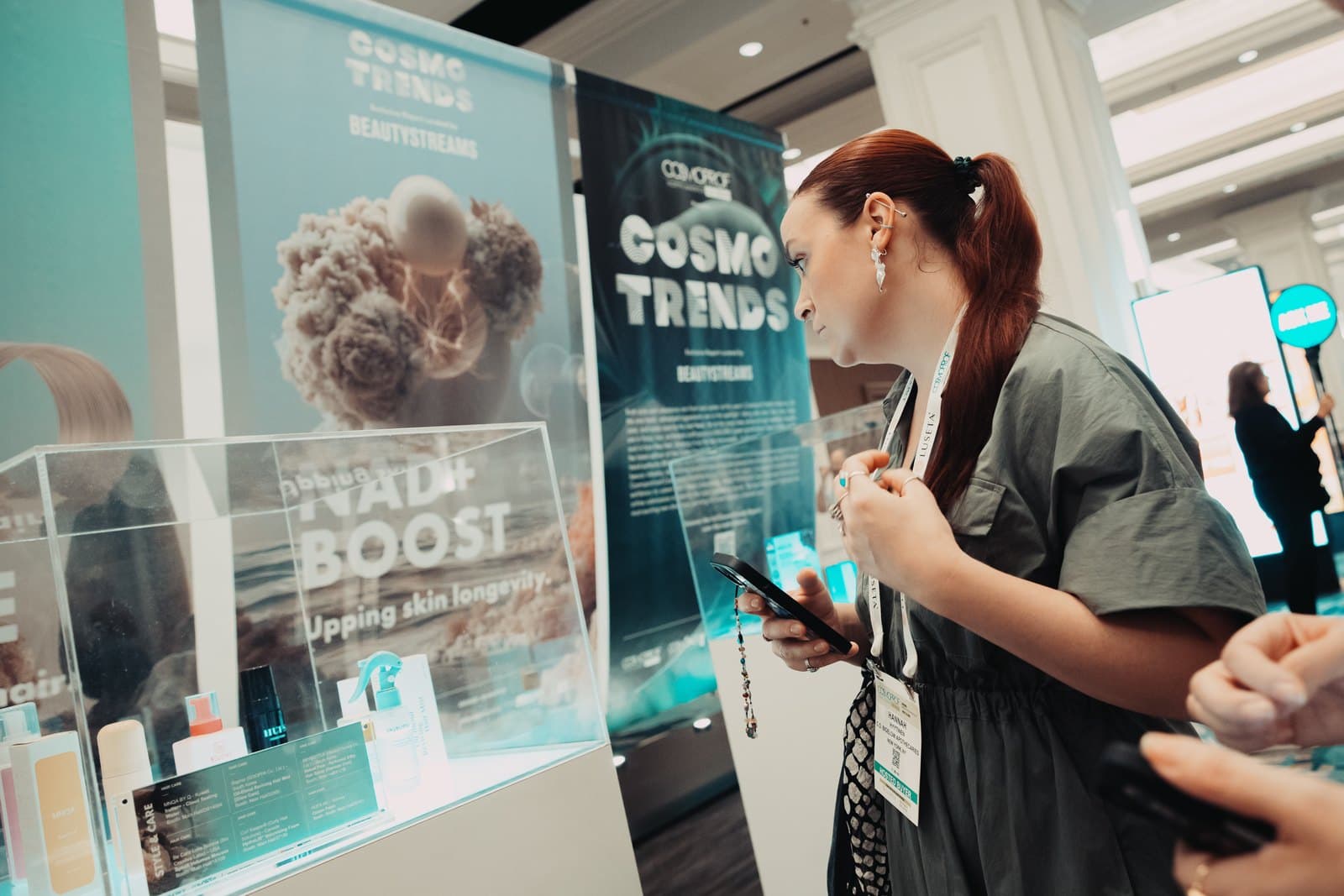
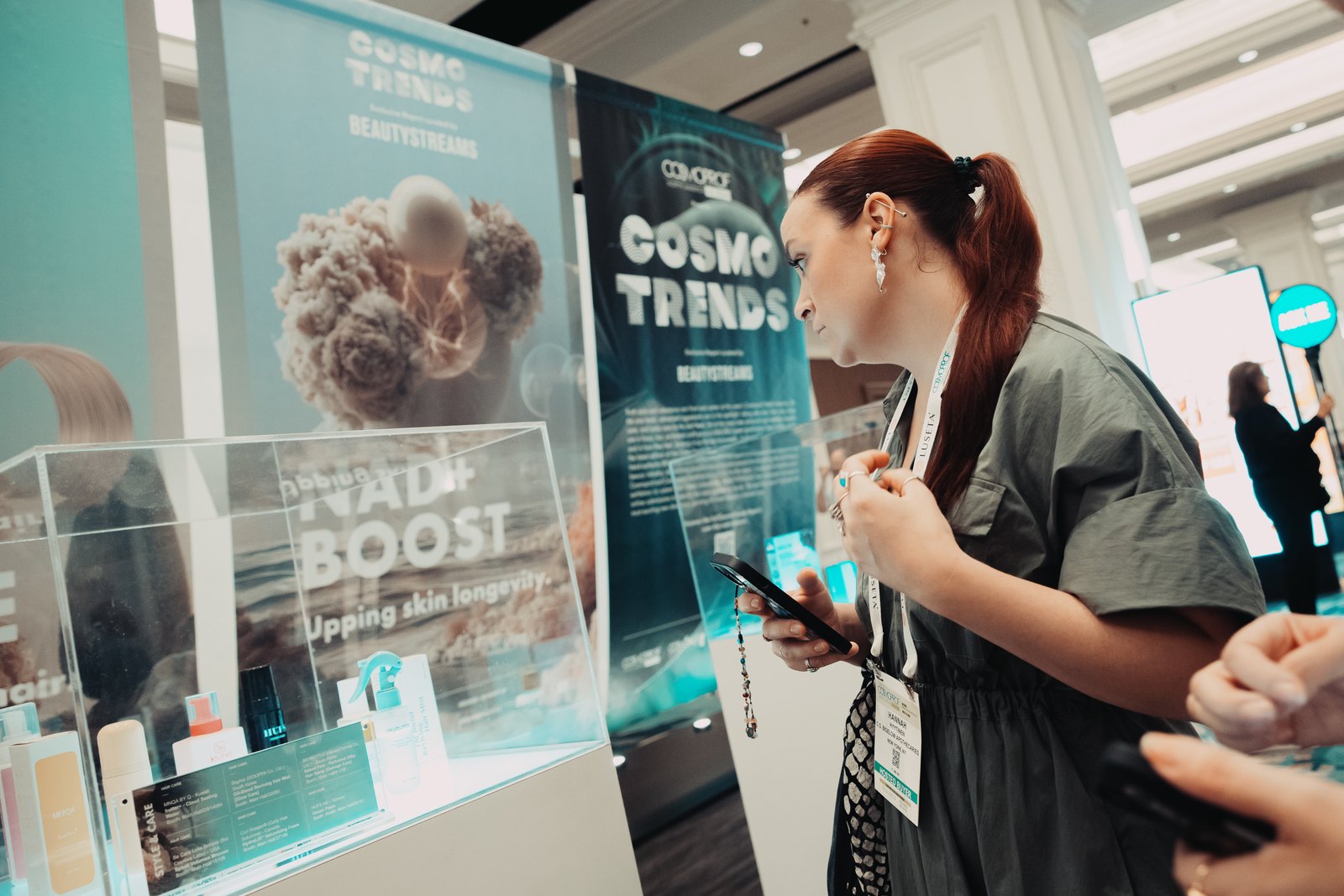
The trend report, published as CosmoTrends and curated with BEAUTYSTREAMS from hundreds of exhibitor submissions, filed it under NAD+ Boost, subtitled upping skin longevity. The market frame it cites: a category valued at 627.75 million dollars in 2024 and forecast to reach 2.15 billion by 2034, a compound annual growth rate above 13 percent, on figures from Insight Analytics. UL Prospector, cited in the same report, puts NAD+ precursors such as NMN at the centre of the 2026 skin longevity story.
What is actually in the case
The products behind the glass are more interesting than the banner above them, because they show how differently exhibitors are solving the same problem.
KIKIGLOW, from South Korea, brought a hydrogel mask that pairs NMN and NAD+ with niacinamide, ceramide and panthenol, and replaces purified water with 70 percent grape water. Its party trick is a temperature-reactive technology: the blue gel turns transparent as it warms on the skin, which the brand presents as a visual cue that the actives have been delivered. The used mask dissolves in warm water to be reused as a body serum.
Standard Seoul put NAD+ into a serum built around a collagen complex that includes a recombinant type III human-like collagen produced by yeast fermentation, alongside glutathione, PHA and PDRN. V-OLA, also Korean, encapsulated NAD+ in a nano-liposome system and suspended it in visible gold thread-like fibres that melt on application. Metamorphosis Light Therapy, from the United States, took the other route entirely and paired its activator serum with red light.
Four exhibitors, four different answers to the same unspoken question.
The delivery problem nobody puts on the banner
Here is why that variety matters. NAD+ is a large, unstable, water-loving molecule. The skin barrier is specifically built to keep exactly that kind of molecule out. An ingredient can have flawless credentials in a petri dish and still be, at a formulation level, a passenger in the jar.
That is why the serious products in the case are not really selling NAD+. They are selling a delivery mechanism: a precursor such as NMN or niacinamide that the skin can use to make its own NAD+, an encapsulation system, a device that increases penetration, or a hydrogel that holds the active against the skin long enough to matter. The brands that led with the delivery technology rather than the ingredient name were, without exception, the ones with the more convincing data folder behind the counter.
The brands that led with the letters NAD+ in large type and nothing else are relying on something different: recognition transferred from the supplement shelf.
Why it is on the shelf now
Two forces are pushing this. The first is that longevity has become a primary skincare goal rather than an anti-ageing sub-segment, and longevity is a word that survives regulatory review far better than most of the alternatives. The second is that the ingredient arrives pre-explained. A consumer who has read about NAD+ in the context of supplements does not need the category educated from zero, which is the single most expensive thing a beauty brand can be asked to pay for.
That is also the risk. Borrowed familiarity is not the same as proven topical efficacy, and the gap between the two is where a category loses consumer trust. Beauty has been here before with stem cells and with peptides sold on the strength of a name.
What a buyer should ask
Three questions separate the formulation from the sticker.
- Is it NAD+ itself, a precursor such as NMN or nicotinamide riboside, or plain niacinamide with a longevity story wrapped around it? All three are legitimate. They are not the same product, and they are certainly not the same cost.
- What is the delivery system, and is there penetration data, not just ingredient data?
- Does the claim survive the pack? Cellular energy and self-repair language sits close to the line that separates a cosmetic from a drug in the United States, and the retailer inherits that exposure when it copies the supplier's claim into its own listing.
What to watch
NAD+ will not stay a hero ingredient. On the evidence of this floor it is becoming a supporting layer, paired with collagen, with PDRN, and with devices, which is what happens to every ingredient that survives its first cycle. The winners will be the companies that can explain, in one sentence a buyer can repeat, why their version reaches the skin.
Read our full report from the show: Cosmoprof North America 2026, where the beauty trade stopped paying for novelty.