
Every technology conference now has its robot moment, and Web Summit 2026 made sure its own came first. On the opening night at the MEO Arena, on November 9, nine AgiBot humanoids performed a synchronised dance for thousands of people, as reported by Euronews and Africanews. For the first time the organisers listed robots as official speakers, and the Chinese delegation was the largest the event has had. Then a van with six wheels arrived with a helicopter folded into its boot.
It was a good show. It was also, for the most part, the wrong thing to look at. The useful part of the evening lasted a few minutes, involved a bottle of water, and came with a number that deserves far more scrutiny than the dancing.
The robot with a shift pattern
Galbot's chief strategy officer, Yuli Zhao, told the opening night audience that the company has deployed more than 1,000 units and runs roughly 200 robot-operated stores in more than 50 cities, as reported by Essential Business. The demonstration was deliberately unglamorous: a robot on a wheeled base, with two arms, retrieving bottled water. Galbot pitches its G1 for convenience stores, pharmacies and factories, as reported by China Daily Asia, citing Xinhua.
That is the opposite of a humanoid. G1 does not walk, does not dance and does not pretend to have a face that means anything. It is a picking machine built for the back half of a small shop, where the shelving is fixed, the catalogue is short and the customer waits behind glass. The stores Galbot runs in Shenzhen look exactly like that: a kiosk with a counter, a wall of boxed goods and a robot doing the reaching.

This is where we part company with the applause. Two hundred stores is a claim made from a stage, not an audited figure, and nobody on the programme asked the questions a retailer would ask first. How many items does one of these stores carry? How many orders an hour does one robot complete, and how many does it drop? What does the unit cost against a person on minimum wage in Shenzhen, and against a vending machine that has done the same job for forty years? Until those numbers exist, a robot shop is a vending machine with better marketing. If they turn out well, it is the first piece of humanoid-era robotics that touches a till rather than a trade show, and it will arrive in convenience retail long before it reaches a department store.
Hands, and who paid for them
The more interesting money was on the exhibition floor. Xynova, founded in 2024, brought two robotic hands to Lisbon: Prima 1, a 22-degree-of-freedom research hand, and Flex 2, a 23-degree-of-freedom hybrid hand that weighs 400 grams, according to the company. Xynova says it has raised about $220 million from investors including CATL, Xiaomi, JD.com and Meituan.
Read the cap table before the specification. JD.com runs one of the largest logistics networks in China and Meituan runs its biggest local delivery business. When two retailers of that size put money into hands rather than heads, they are telling you where they think the bottleneck is. Walking is solved well enough for a warehouse. Picking up an unfamiliar object, a soft bag of rice next to a glass jar, is not. Every store robot that matters will be judged by its grip.
UBTech's Walker C1, by contrast, spent its time on stage talking to a presenter about greeting visitors and giving tours. "We take on the repetitive, the heavy, the precise. Humans keep the creativity, the judgement, the warmth," the robot said, as reported by Essential Business, which was careful to point out that the exchange was staged. It is a pleasant line written by a marketing team. A greeter is the least useful job a store robot can do, because it is the one job where the human is the point.
The aircraft in the boot
Then came the flying machine. Zhao Deli, founder of XPENG's flying-car unit, presented the Land Aircraft Carrier: a six-wheeled road vehicle that stores a compact two-seat electric aircraft in its rear compartment, with a separation process the company puts at five minutes, as reported by Essential Business. The company claims more than 7,000 pre-orders. Zhao told Xinhua that the first uses will be recreational flying and emergency rescue, before point-to-point transport, as reported by China Daily Asia.
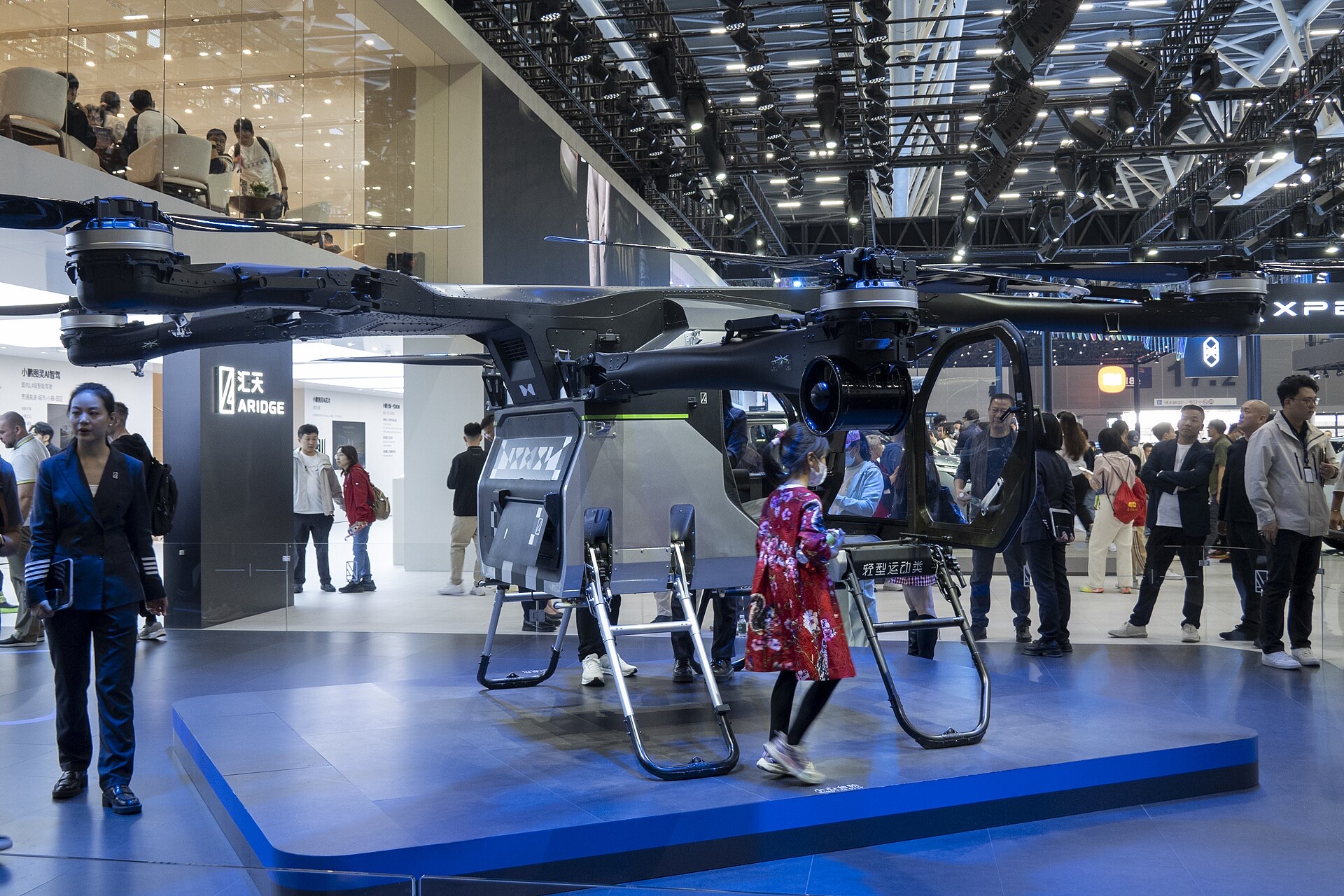
Seen up close it is less a flying car than a large drone with seats, and that is its strongest argument. The retail interest is not in a commuter skipping traffic. It is in the supply chain behind it: Zhao's case for affordability rests on China's electric vehicle supply chain, the same one that made cheap batteries and motors available to everything from scooters to delivery robots. If that chain can produce a certified passenger aircraft at scale, it can produce cargo drones at a cost Western logistics will struggle to match. Regulation, not engineering, stands in the way in Europe, and that is a slower and more political problem than anything shown on stage.
The quiet voice from the pavement
The most grounded comment of the week came from a European veteran of the field. Ahti Heinla, co-founder of Starship Technologies, whose small delivery robots already work pavements and campuses, told Xinhua that China's manufacturing scale is its advantage in physical AI, and that Chinese road-going autonomous vehicles and Starship's sidewalk robots are "complementary solutions", as reported by China Daily Asia. It is a diplomatic answer. It is also an admission that Europe's best-known delivery robot company now describes its place in the market by reference to Chinese hardware.
Our verdict
Web Summit 2026 confirmed what our preview expected: the robotics conversation has moved east, and it has moved from software to bodies. But a conference rewards the robot that performs, and retail should reward the one that works. The dancing humanoids will be back next year doing something more elaborate. The question to carry out of Lisbon is smaller and harder: what does Galbot's water bottle cost to deliver, and how often does the robot drop it? The first company to publish that number honestly will have earned more attention than anyone on Centre Stage.
Sources: Essential Business, "Robots, flying cars and the AI revolution take centre stage as Web Summit opens in Lisbon", November 10, 2026; China Daily Asia, citing Xinhua, "Chinese firms show robots, flying cars and open AI models at Lisbon Web Summit", November 2026; Euronews, "Lisbon Web Summit 2026 opens with humanoid robot speakers and record Chinese delegation", November 9, 2026; Africanews, "Portugal: Humanoid robots take centre stage at Web Summit 2026", November 13, 2026; Xynova, "Giving AI a Hand: Xynova Brings Physical Dexterity to Web Summit 2026", October 27, 2026, via the Web Summit press release room.