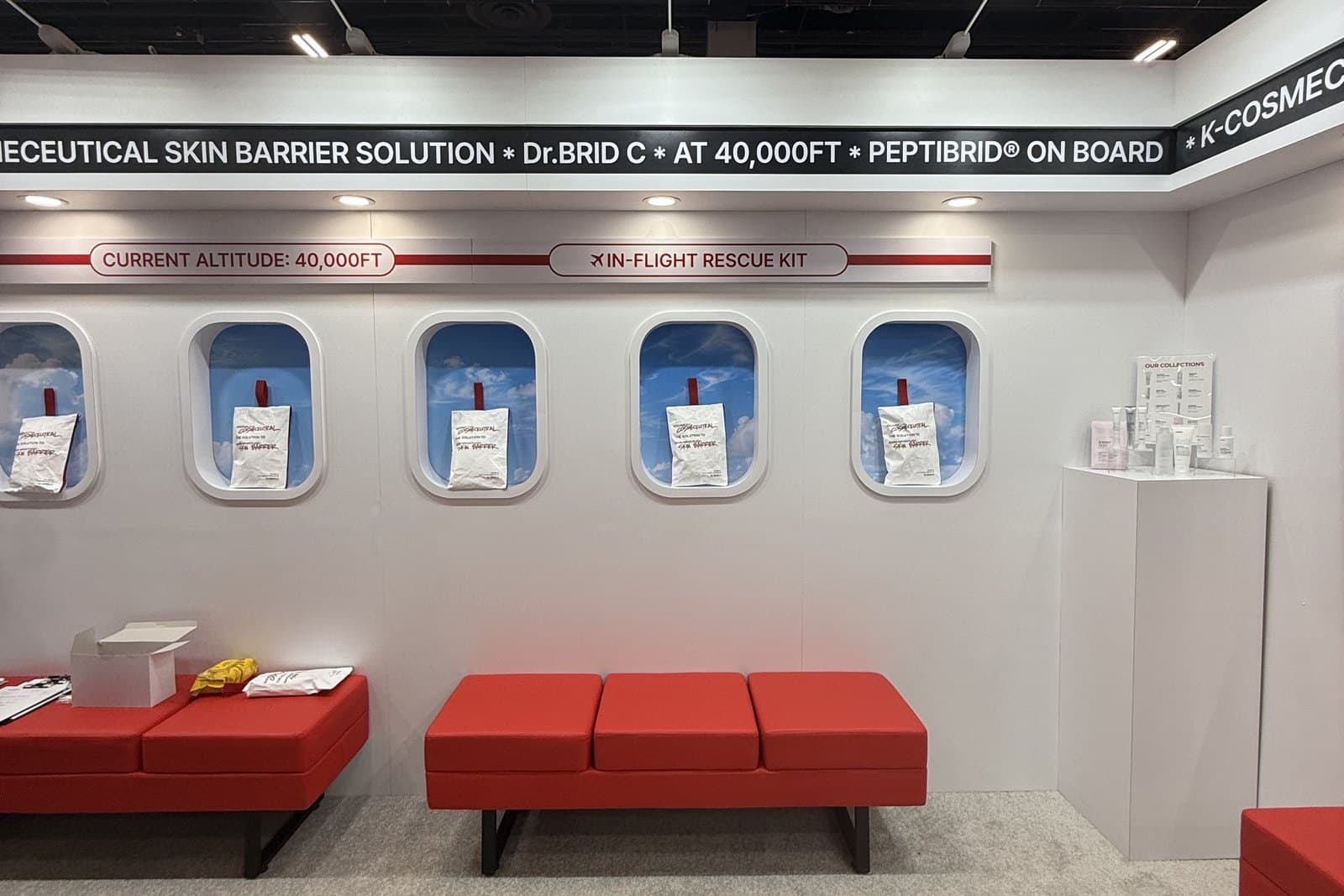
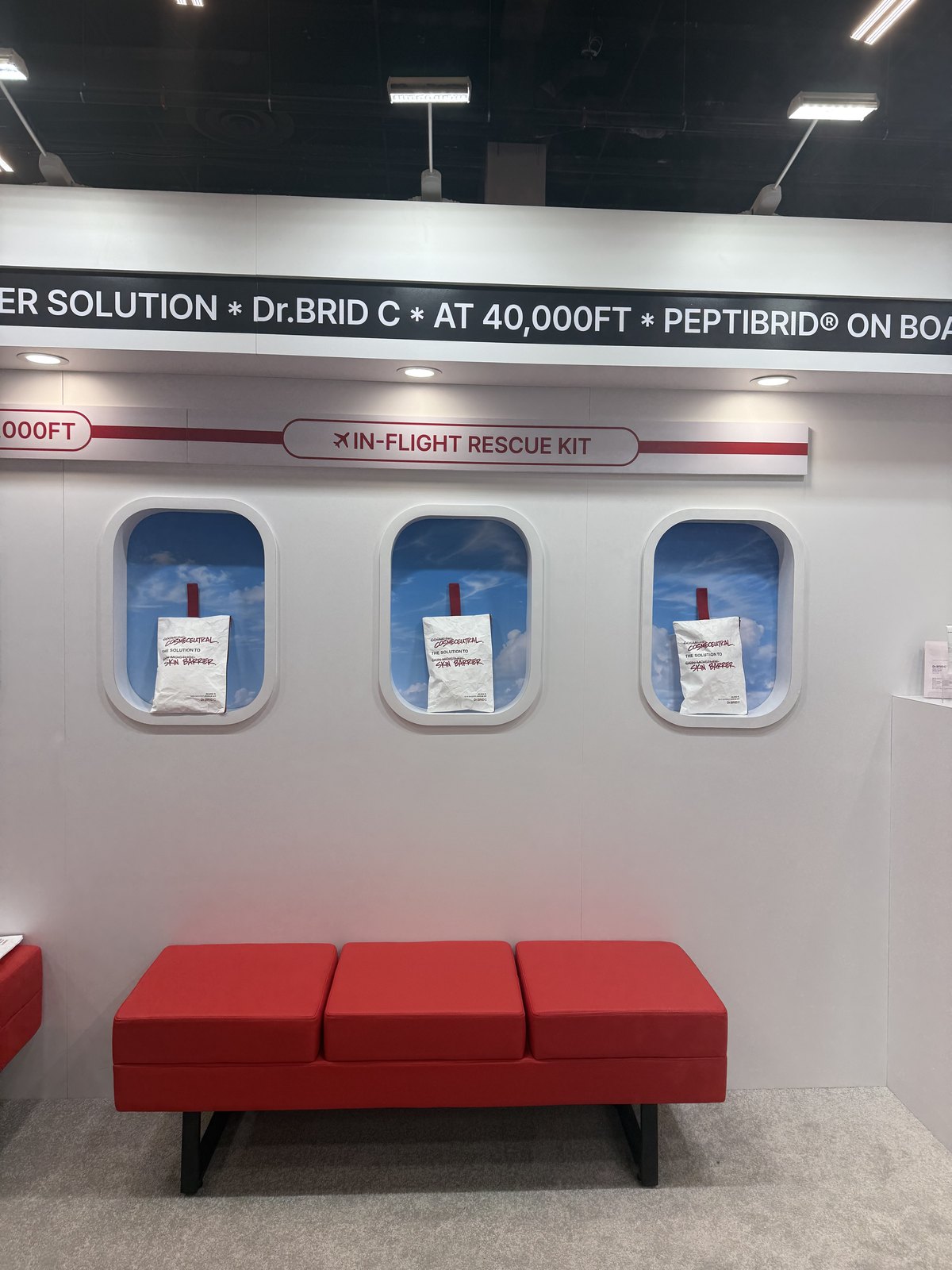
LAS VEGAS. Somewhere in the skincare aisles at Mandalay Bay, a stand had stopped pretending to be a stand. White curved bulkheads, a black destination band running the perimeter, five aircraft windows cut into the wall with a blue sky behind them, red bench seats bolted low to the floor and a sign that read current altitude: 40,000ft. A cabin service trolley stood at the front holding the product line, as though the crew had just started the pass.
This was Dr.BRID C, a Korean brand that describes its category as cosmeceutical rather than cosmetic and its promise as defense before beauty. The set was the argument, and it was one of the most efficient pieces of communication we saw all week.
The origin story is doing structural work
The brand's telling is that the product was conceived at 40,000 feet, in a cabin whose relative humidity, by its account around 15 percent, is drier than the Sahara. That framing does something clever. It converts an abstract benefit, barrier protection, into a place a buyer has personally been, in the worst possible skin conditions, for eleven hours, three weeks ago.
Every serious skincare pitch this year involved the barrier. What almost none of them had was a setting. Dr.BRID C picked the one environment where a Western buyer already believes their skin degrades measurably, and built the whole stand inside it.
The manifesto poster at the stand is blunter than the products are:
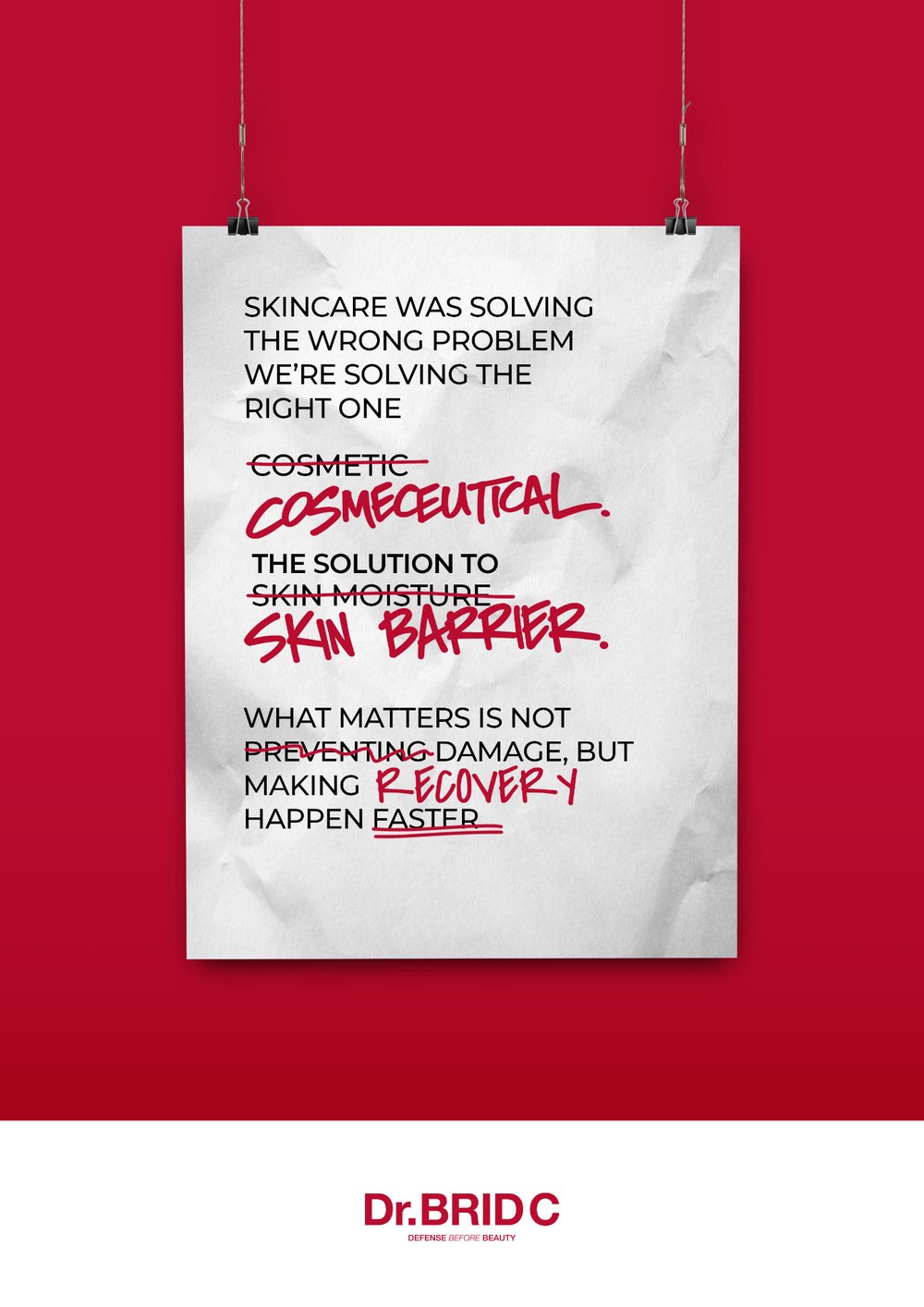
Read as strategy rather than as a poster, those three substitutions are the whole 2026 skincare floor in one page. Moisture became barrier because barrier sounds like a structure that can be measured. Prevention became recovery because recovery gives the consumer a reason to buy on the day something already went wrong, which is a far larger and more urgent occasion than prophylaxis.
What the line actually is
The products under the theatre are ordinary in the good sense: a small, legible range with two clear entry points.
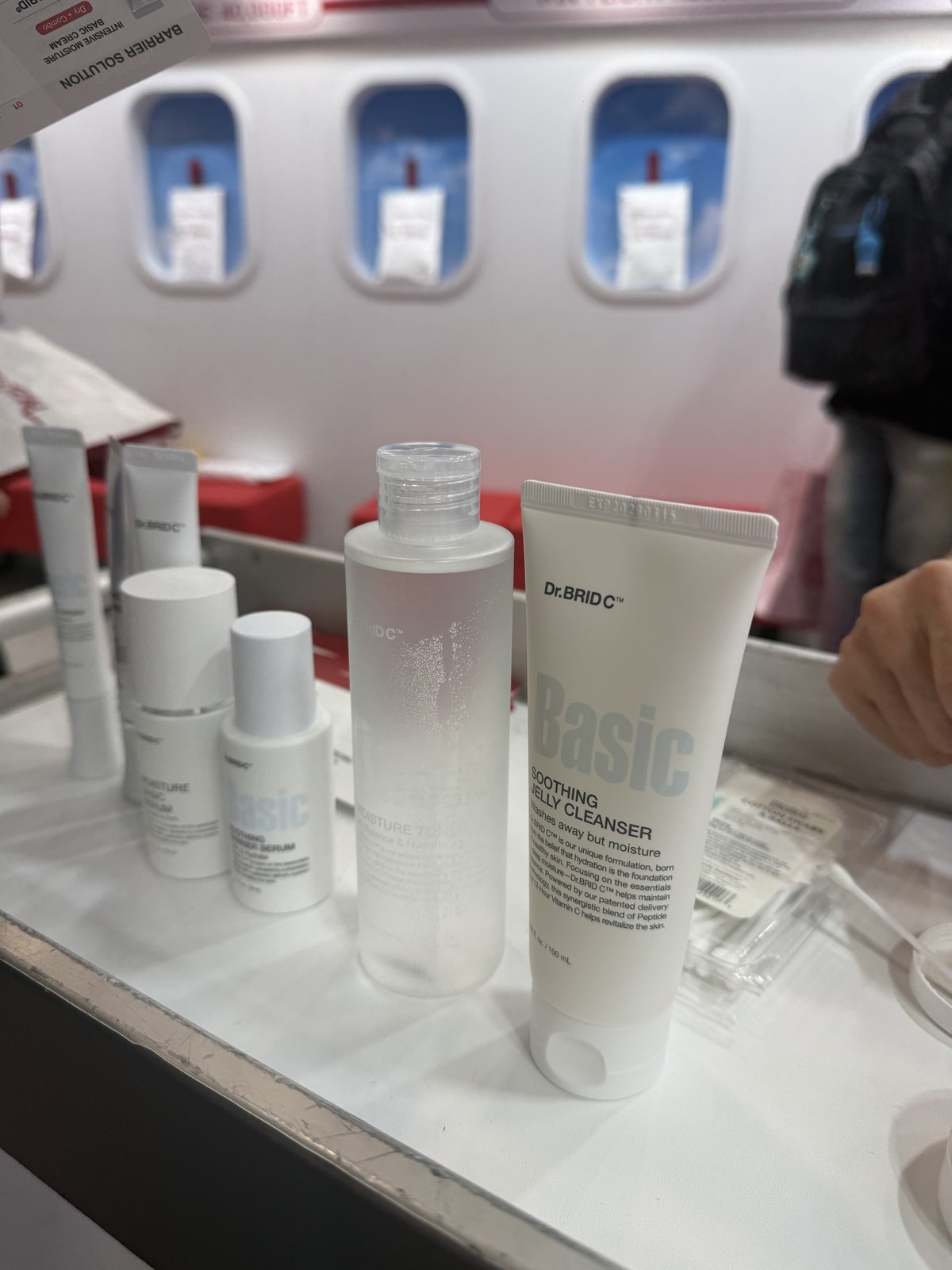
The night cream is positioned as the last step of an evening routine, and the company's claims sheet cites a 90,000 ppm shea butter blend against moisture loss and a patented peptide delivery technology, which it says increased C-peptide collagen synthesis by 175.3 percent in vitro. The cleanser is a jelly-to-foam texture built on mild protease enzymes and amino acid surfactants, at a stated pH of 5.2 to 6.2, with a dermatological test the brand reports at a 0.00 irritation score.
Those are the brand's own figures, presented as such. The in vitro number in particular deserves the qualifier it comes with: a percentage measured on cells in a dish is a formulation signal, not a promise about a face. We wrote separately about how these numbers are being used across the floor, because Dr.BRID C is far from the only brand printing them.
What is notable commercially is the restraint of the range itself. Cleanser, toner, serum, two creams. In a hall where the median Korean exhibitor arrives with twenty SKUs and no hierarchy, a five-piece line with an obvious hero is a merchandising decision, not a limitation.
The booth as a media channel
The stand ran a recurring activation it called Turbulence Hour: every hour, on the hour, the screens announced that at 40,000 feet barrier stress and moisture loss may occur, and the first fifty visitors who reached a member of the crew got a skin barrier tool while supplies lasted. The last panel of the sequence pushed the whole thing to Instagram.
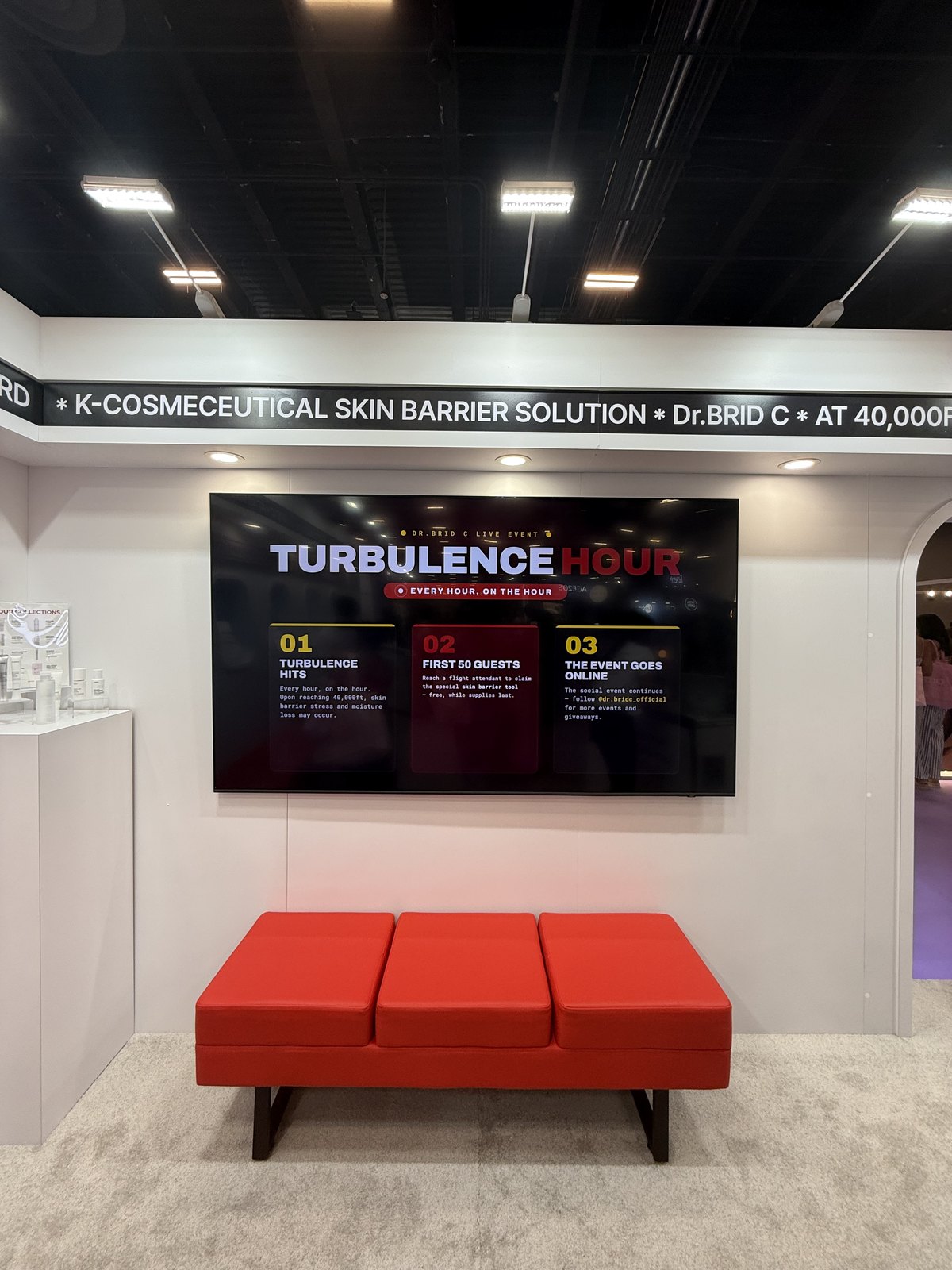
It is a small idea that solves a real trade show problem. A stand at Cosmoprof is not competing with the stand opposite, it is competing with fatigue: a buyer with 950 exhibitors on the floor plan and eleven appointments will remember four stands by Wednesday. An hourly event gives the same visitor a reason to come back, gives the crew a fresh opening line, and converts dead time into a queue that other buyers can see from the aisle. Queues are the cheapest signage in a convention centre.
Where the set stops helping
The obvious risk is that none of it travels. On a shelf in a pharmacy or a marketplace listing there is no fuselage, no altitude sign, no crew and no hourly alert. What survives is a tube, a claim and a price, and at that point the brand is back to competing with every other barrier cream in a category where barrier has become the default word.
The second risk is definitional. Cosmeceutical is a marketing term, not a legal one, and in the United States it carries no regulatory status at all. A brand that leans on it in its positioning is making a promise the label itself cannot make, and it will be tested first by retailer compliance teams rather than by consumers.
Still, the stand answered the question this edition kept asking. Not what is new, but why does this deserve shelf space. Dr.BRID C's answer was a place, a moment and a mechanism, in that order, and it was legible from ten metres away in a hall where most stands were not legible from two.
Read our full report from the show: Cosmoprof North America 2026, where the beauty trade stopped paying for novelty.