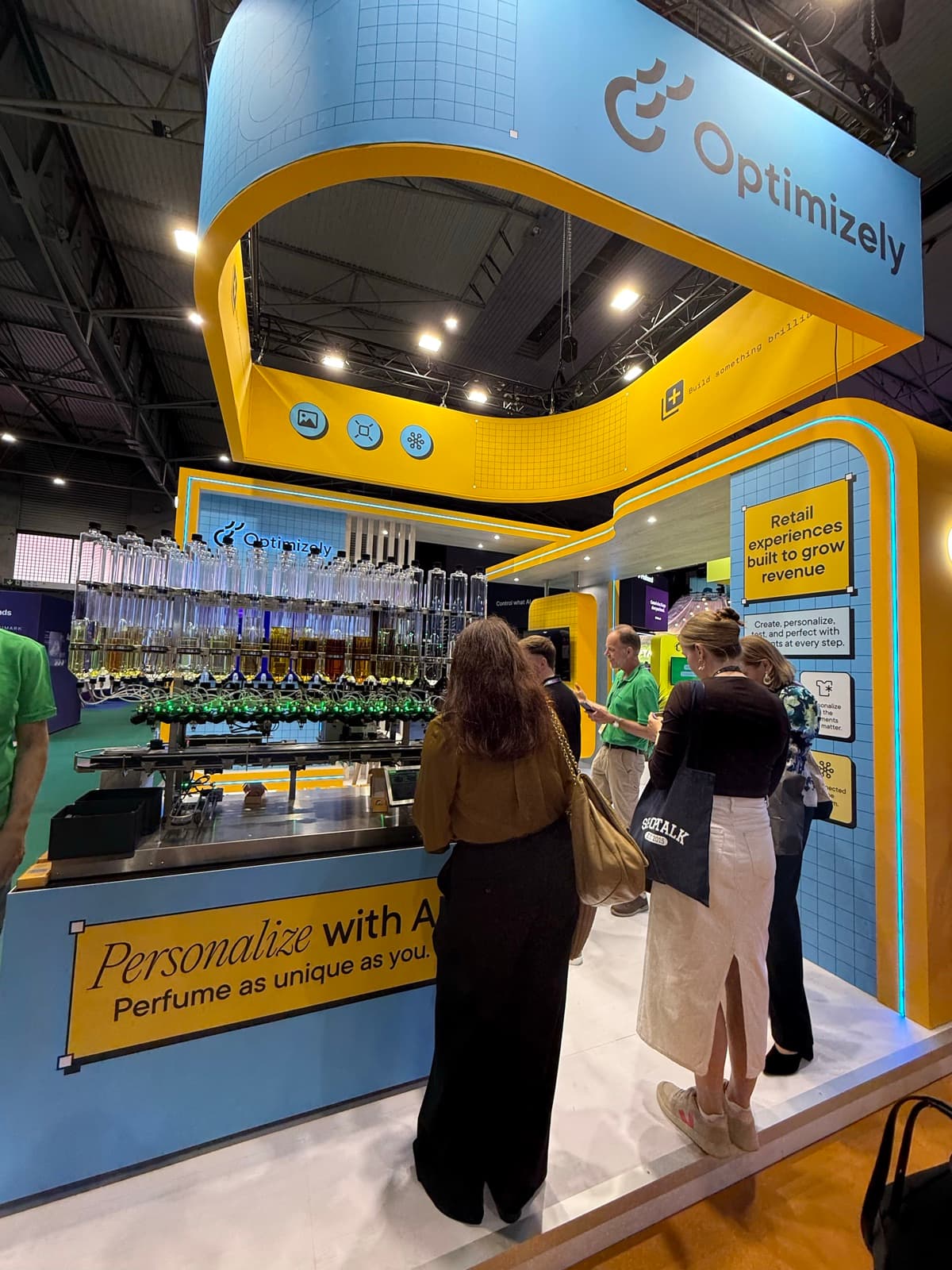
The most reliable crowd on the Shoptalk Europe exhibition floor in Barcelona was not gathered around a keynote screen. It was queuing at the Optimizely stand, where a machine was mixing personalized perfume on the spot, one visitor at a time. We watched it work, photographed it (above), and the mechanics are worth taking seriously.
The flow is simple from the visitor's side. You answer a conversational AI's questions about the scents you love, the perfumes you already wear, the memories you want the fragrance to touch. The system translates that conversation into a formula, and a blending machine dispenses your bottle in front of you. The technology behind this kind of activation comes from Algorithmic Perfumery, the AI scent-creation platform built by EveryHuman, a Dutch studio founded by artist-technologist Frederik Duerinck and scent designer Anahita Mekanik, whose team has been building the system since 2018 through their startup ScenTronix in Breda.
The interesting part is the compression
Bespoke perfume is one of the oldest luxury services in existence. What it has never been is fast, cheap, or scalable. A traditional bespoke fragrance is a months-long correspondence with a perfumer and a four- or five-figure invoice.
The algorithmic version compresses that into minutes. Working with perfumers, the team distilled its scent library into 46 building blocks, which the algorithm can assemble into more than 500 billion possible combinations. The machine is not choosing from a shelf of pre-made juices, it is composing, within a formula space designed by human perfumers, and then physically blending the result.
Whether any given output rivals a Grasse atelier is the wrong question. The right question is the retail one: what happens to the fragrance category when genuine personalization costs roughly what a mid-tier bottle costs and takes fifteen minutes?
From art installation to shop floor
It would be easy to file this under trade-show theater, and to be fair, at Shoptalk it partly was: Optimizely runs the activation as a crowd-puller, a physical metaphor for the AI-personalization software it actually sells, and the booth staff were politely selective about who got a bottle.
But the model has already crossed into real retail. The Fragrance Shop, the UK's largest independent fragrance retailer, has partnered with EveryHuman to bring algorithmic scent creation to its customers. The concept has run a residency on Spring Street in New York's Soho, and it appeared at Paris Perfume Week this year as a paid, reserved experience. The trajectory, from Ars Electronica-awarded art project to trade-show magnet to store fixture, is the classic path of a retail technology that starts as spectacle and ends as infrastructure.
What it signals for the category
Fragrance is the last beauty category still sold almost entirely blind. Foundation gets shade-matched by camera, skincare gets diagnosed by questionnaire and increasingly by AI, but perfume discovery still mostly means spraying strips in a duty-free aisle. A conversational engine that maps preference to formula attacks exactly that gap, and it produces something the industry has never had at scale: structured data about what individuals actually want to smell like, upstream of any brand.
That is why the queue in Barcelona mattered. The people waiting were not consumers, they were retail executives. Every one of them was watching a category's discovery problem, sampling problem, and personalization story get solved by one machine, and most of them were doing the same mental math we were: if this works for perfume, the most emotional and least data-fied product in beauty, the rest of the shelf is next.