Inditex published its results for the first half of fiscal 2026 on Wednesday, September 9. By most measures it was a record half. Sales grew 7.6% to 19.8 billion euros, or 9.2% in constant currency, and net income rose 6.8% to 3.0 billion euros, according to the company's release. The market still marked the shares down. The reason sits in one line of the release, and it is worth reading closely.
The headline numbers
Gross profit rose 8.3% to 11.6 billion euros, and the gross margin reached 58.7%, 40 basis points above the first half of 2025, according to the release. EBITDA grew 7.8% to 5.5 billion euros and EBIT 7.6% to 3.8 billion. Inventory was 9.3% higher at the end of July, and the net cash position stood at 10.4 billion euros.
The second quarter on its own brought net sales of 11.01 billion euros, up 9.1% and about 1% above consensus, as reported by Investing.com. Operating profit for the quarter was 2.09 billion euros, a 19% margin, against analyst expectations of 19.7% to 20.3%. Shares fell more than 2% after the announcement, Investing.com reported.
Margin up, opex up faster
The line in question: operating expenses increased 8.3%, and including all lease charges they grew 50 basis points above sales growth, according to the release. That is a small gap. For a company whose investment case rests on doing more with each euro of sales, it is also the wrong direction.
Management gave a cause. "Despite the headwind of elevated transport and input costs we highlighted back in the first quarter resulting from disruptions in the Middle East," chief financial officer Andrés Sánchez told analysts, as reported in Investing.com's transcript of the earnings call. Higher freight touched both the gross margin and operating expenses, through online fulfilment and distribution costs. Inditex also has around 480 franchised stores in the Middle East, and all of them are currently open, its head of investor relations said on the call.
The striking part is that the gross margin went up anyway. Freight got more expensive and Inditex still kept more of every euro it sold at the gross level. Chief executive Óscar García Maceiras pointed to the mechanism, the ability "to allocate product efficiently across different markets, to support product availability, and to maximize full price sales," according to the same transcript. Selling more at full price is what absorbs a cost shock before it reaches the margin. We described that system in detail in Inside Inditex's real-time machine: this half is the stress test, and the system passed it at the gross level and leaked slightly below it.
Fewer stores, younger brands carrying growth
Inditex ended the half with 5,444 stores, according to the release, down from 5,528 a year earlier, as reported by FashionNetwork. Sales grew faster than the store count shrank, which is the store optimisation strategy the company says is still running.
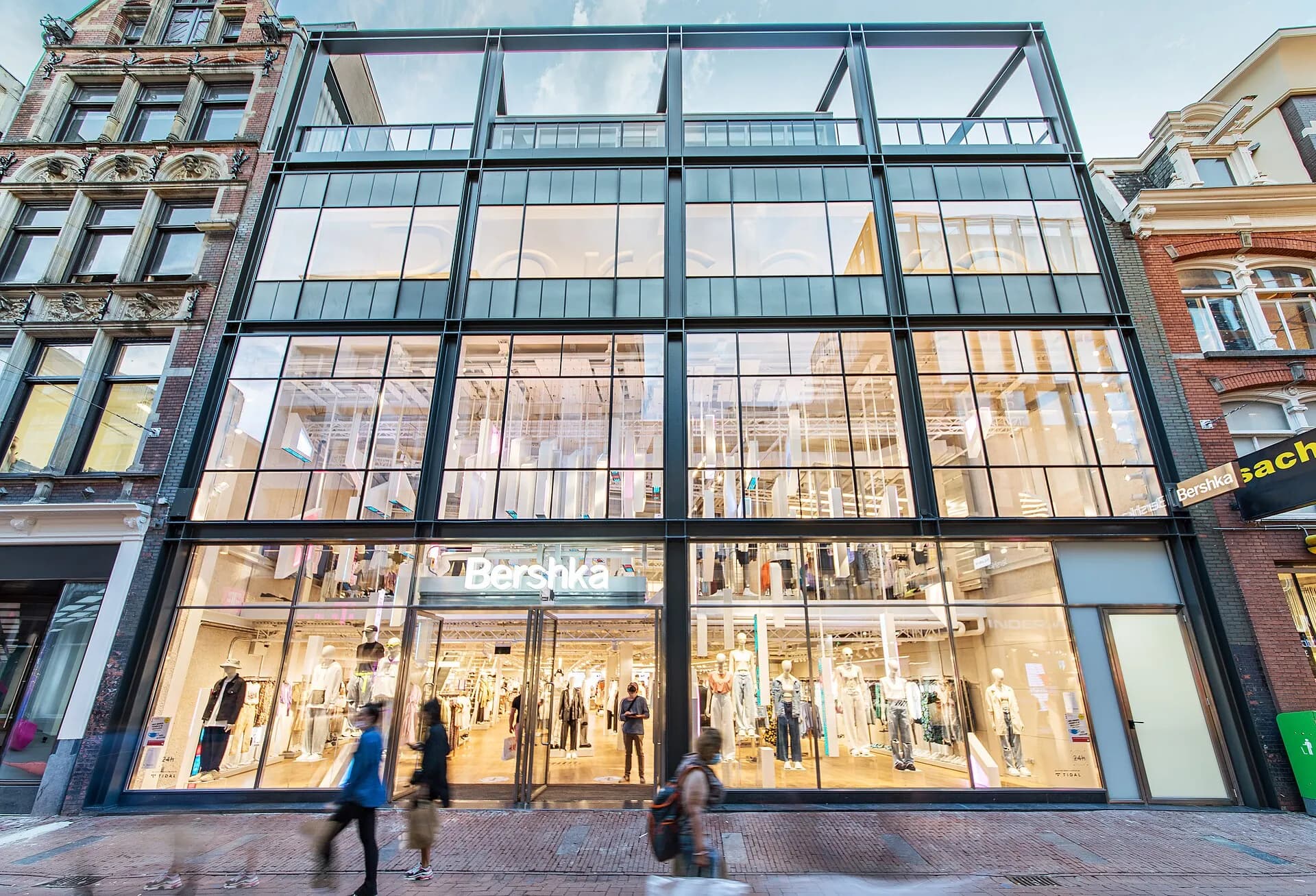
The brand split is where the growth actually came from. Zara, including Zara Home and Lefties, sold 13.78 billion euros, up 4.8%, as reported by FashionNetwork. Bershka grew 16.7% to 1.68 billion euros, Stradivarius 18.5% to 1.57 billion, and Oysho 21.3% to 472 million. Pull&Bear rose 8.9% and Massimo Dutti 10.4%. The flagship is still the bulk of the group, but in this half the smaller chains did the accelerating.
Two operational notes from the release fit that picture. Bershka opened its first store in the United States in August, at Aventura Mall in Miami. And "the new soft-tag technology has now been implemented in all of our stores," the company said, a store-level upgrade now running across all 5,444 doors.
The autumn started fast
Store and online sales in constant currency between August 1 and September 7 rose 9% compared with the same period of 2025, according to the release. Analysts had expected 7% to 7.5%, as reported by Investing.com. For 2026 the company guides to gross space growth of around 5%, a gross margin within 50 basis points of last year's level, and a currency headwind of about 1% on sales.
The contrast with the cheapest model
The week matters because of who else is in it. Shein listed in Hong Kong on September 1, and its shares finished the first day just under the listing price, valuing the company at around 26 billion dollars against the 100 billion dollars of its 2022 funding round, as reported by NPR. Inditex and Shein are the two poles we described in Europe's fashion mid-market squeeze: one competes on speed and full-price sell-through in its own stores, the other on the lowest possible price shipped parcel by parcel. Both are now exposed to the same freight costs. This week, one of them showed it could still widen its gross margin through them.
What to watch
Three things. First, whether operating expenses fall back in line with sales in the second half, or whether transport costs keep running ahead of what full-price selling can absorb. Second, whether the 9% start to the autumn holds through the bulk of the season, which is where the full-year margin is decided. Third, whether the younger chains keep growing at double digits, and whether Bershka's American debut stays a single store or becomes a second US growth line next to Zara.
Sources: Inditex, "Interim Half Year 2026 Results", September 9, 2026; Investing.com, "Inditex shares fall as profit miss overshadows strong sales", September 9, 2026; Investing.com, "Earnings call transcript: Inditex posts solid H1 2026 growth as shares fall", September 9, 2026; FashionNetwork España, "Inditex elevó sus ventas un 7,6 % en el primer semestre y rozó los 3000 millones de euros de beneficio neto", September 9, 2026; NPR, "Shein makes lackluster debut on the Hong Kong stock exchange", September 1, 2026.