Carrefour published its third-quarter sales on Tuesday, October 20, and the release says two different things. The quarter itself was ordinary in the best sense: group sales of 22.69 billion euros, up 2.3% like for like after 2.1% in the first half, according to the company. The outlook was not. Three days after looting hit shops in several French cities, Carrefour cut every financial target it had set for 2026 and told investors that its home market was in "an unprecedented situation."
The shares fell 14% after the announcement, as reported by CNBC, on a quarter in which sales did exactly what the company had promised.
What actually changed
The third quarter closed on September 30. The looting came on the weekend of October 17 and 18, after weeks of cost-of-living and student protests, as reported by Euronews. Interior Minister Laurent Nuñez admitted that authorities had "lost control" in some major cities on the Saturday, and Prime Minister Sébastien Lecornu asked prefects to impose "very limited" and "localized" curfews, as reported by ABC7 New York, citing the Associated Press. Euronews listed Carrefour, Franprix, Monoprix and Intermarché Express among the supermarket names hit, in Paris, Lyon, Marseille, Bordeaux and other cities.
So the 2.3% is clean, and the guidance cut is a forecast about the fourth quarter. Carrefour now expects operating margin to grow by zero to 15 basis points, against 25 before. Adjusted earnings per share go from high single-digit growth to "stable to slight growth." Net free cash flow goes from slight growth to a slight decline. Capital spending drops from 1.7 to 1.6 billion euros, and the company says the cut is in France.
The repair bill is the small number
Euronews reported Alexandre Bompard, Carrefour's chairman and chief executive, as saying that repairs would cost "well over ten million euros," with 19 Carrefour convenience stores and supermarkets among the shops targeted. For a group with 66.5 billion euros of sales in nine months, that is noise.
The release is clear that the damage is somewhere else. Carrefour lists four things: lower footfall, shorter opening hours because of curfews, higher security costs and higher logistics costs. It also says consumer confidence was "already weakened by rising energy prices." Each of those hits a cost base that is set in advance, in the weeks before Christmas, which are the weeks that carry a grocer's year. A store that closes three hours early still pays its lease and most of its staff. A truck that needs an escort costs more per delivery. None of it shows up as broken glass.
That is why the cut looks large next to the incident. The market is not pricing a weekend. It is pricing a quarter in which Carrefour cannot say when, or for how long, its city stores will open.
The exposed format is the growth format
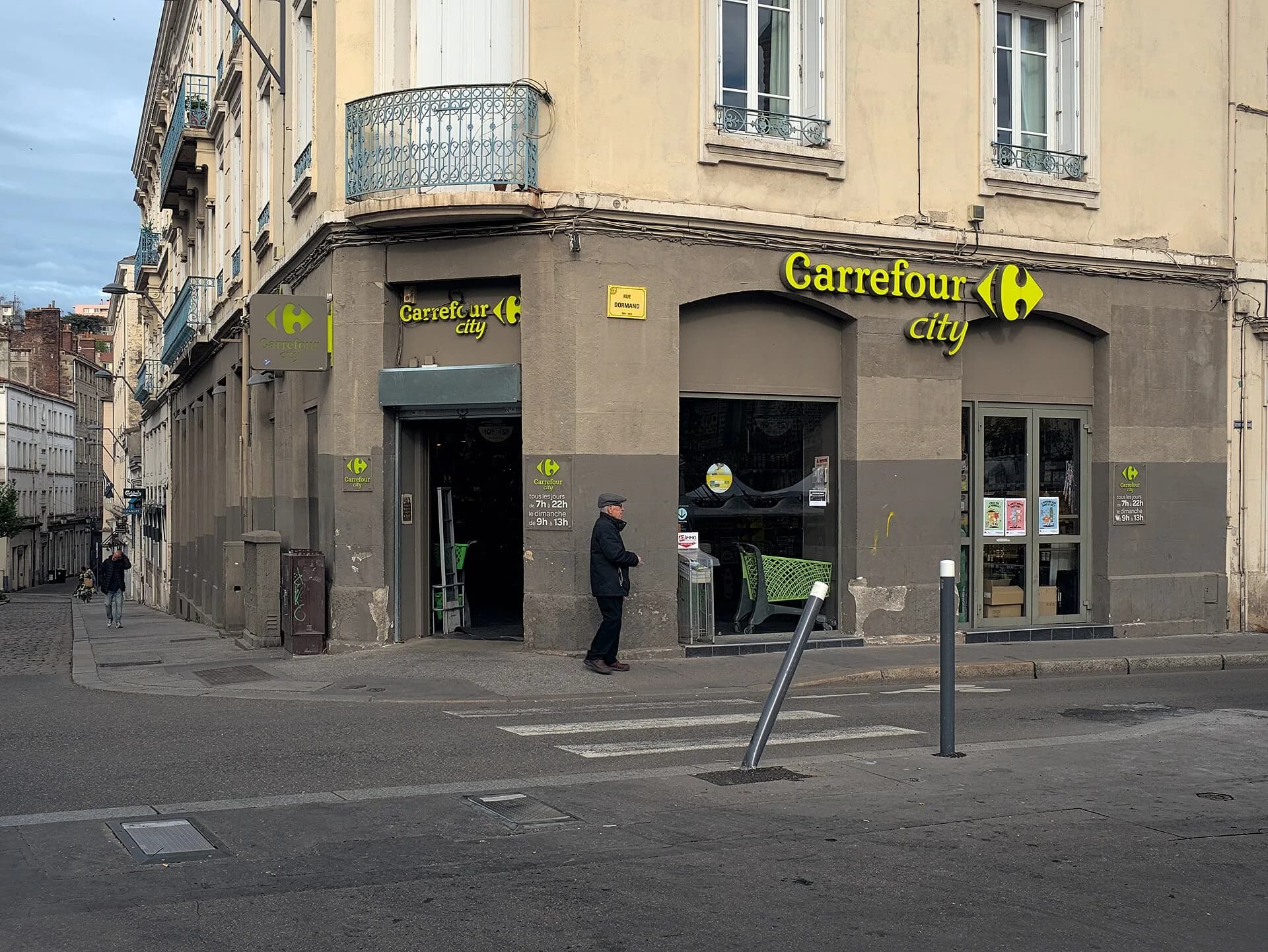
Here is the part that should worry Carrefour most. The stores the curfews reach are not the hypermarkets on ring roads. They are the urban convenience stores and supermarkets, and that is where the company is putting its money.
In France, convenience grew 3.3% like for like in the quarter, the best of any format, while legacy hypermarkets fell 0.6%. Carrefour opened 54 convenience stores in France in the quarter, and 89 across France and Spain. The day before the results, it announced an agreement to buy Codifrance, a franchise specialist in local food retail, explicitly "to strengthen Carrefour's leadership in the convenience store format." The Carrefour 2030 plan is, in large part, a bet that French shoppers will buy more often, closer to home, in smaller baskets.
The strategy is sound in normal times, and the numbers support it. What last week showed is that the format has a risk the plan did not price: it sits on the streets where social unrest happens, it depends on long opening hours, and it is often run by franchisees, whose staff Euronews reported will be moved to short-time work. A hypermarket can absorb a bad week. A convenience store under curfew loses the evening trade that justifies its rent.
What the quarter still says
Strip the outlook out and the operating story is better than the share price suggests. The former Cora stores, bought in 2024, grew 7.3% like for like after 5.0% in the second quarter and 2.3% in the first, so the integration is working. Price cuts on more than 500 products in August, averaging 8%, lifted Carrefour's Net Promoter Score in France by two points, the company says. E-commerce grew 18% at group level. Spain grew 2.1% on volume. In Brazil, Atacadão accelerated to 2.0%, and Sam's Club grew 3.6% on more active members, a detail worth reading next to Walmart's own membership push in the United States.
The weak spots were already there before the unrest. Non-food fell 2.2% in France and 1.1% across the group. Poland fell 4.3% in a deflationary market. In Brazil, Carrefour Retail shrank 2.3% after the group shut its non-food e-commerce there.
And there is one quiet casualty of the new guidance. Carrefour has equipped 28 French hypermarkets with Vusion's electronic shelf labels, connected rails and cameras, using AI to catch out-of-stocks and pricing errors. That is exactly the kind of spending a 100 million euro capex cut in France tends to slow. Bompard says the roadmap "remains unchanged." The budget for this year says it is a little slower.
What to watch
Three things. How long the curfews last, and in how many cities, because opening hours are the variable Carrefour named first. Whether the other French grocers with large urban networks, starting with the owners of Franprix and Monoprix, describe the same pressure in their own updates. And whether Codifrance closes on the same terms: buying more convenience stores is still the right long-term call, but this week it became a call that carries a security bill. We will come back to it with the full-year results.
Sources: Carrefour, "Q3 2026 sales" press release, October 20, 2026; Retail Insight Network, "Carrefour cuts 2026 outlook following French store disruption", October 21, 2026; CNBC, "Carrefour stock falls 14% after outlook cut amid 'unprecedented' Paris protests", October 21, 2026; Euronews, "Businesses and shopkeepers pick up the pieces after protests in France spiral into looting", October 18, 2026; ABC7 New York, "France protests: Prime minister calls for localized curfews in cities to curb rioting and looting", October 19, 2026 (Associated Press).