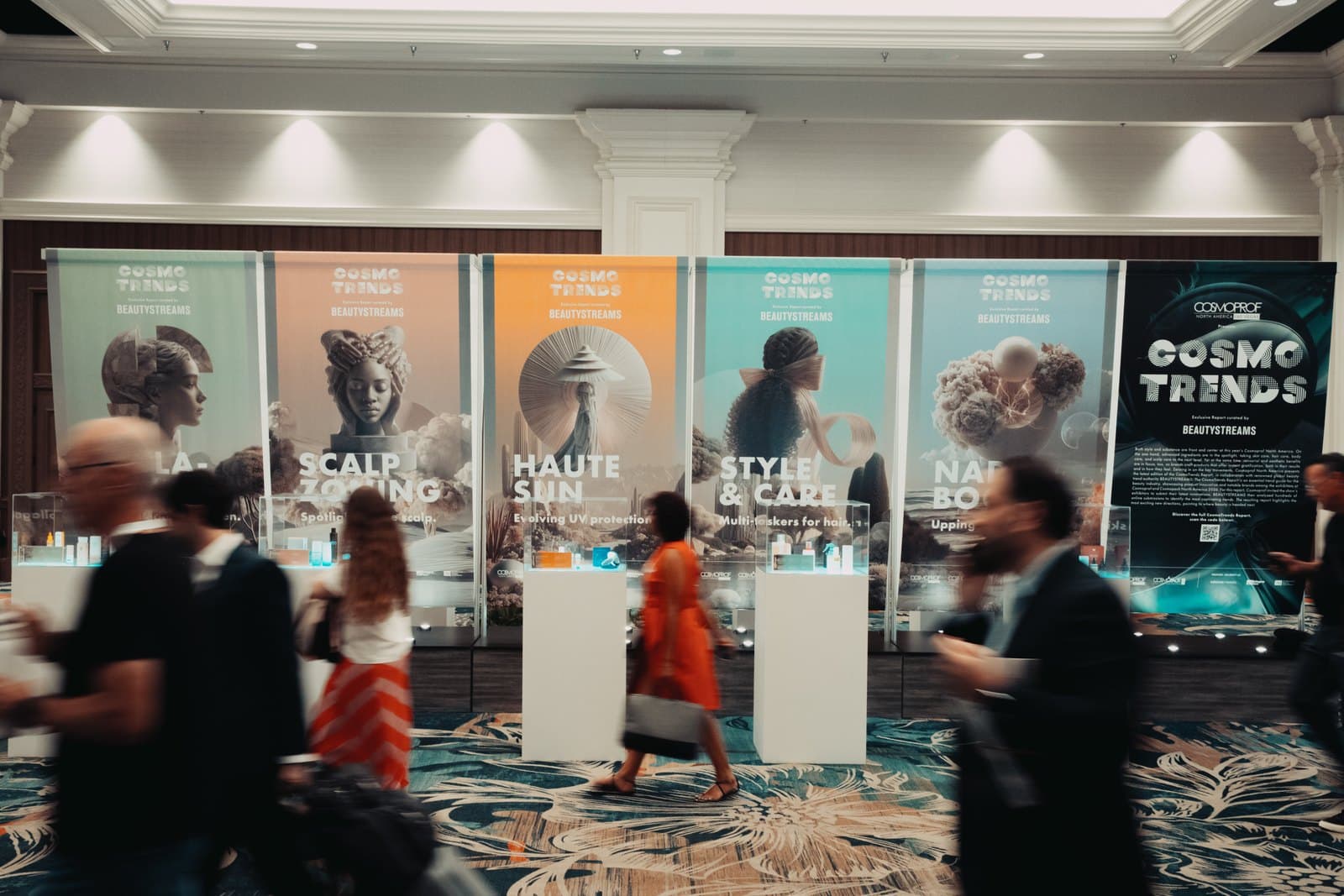
LAS VEGAS. In a ballroom off the main hall at Mandalay Bay, five backlit banners stood in a row above five glass cases. NAD+ Boost. Haute Sun. Scalp Zoning. Style & Care. Colla-Genius. Between the cases, a steady traffic of buyers stopping, photographing the labels and moving on.
That is the CosmoTrends showcase, the physical version of the report Cosmoprof North America publishes with BEAUTYSTREAMS. The method is worth knowing before the conclusions: exhibitors submit their new products, the trend agency analyses hundreds of those submissions, and the result is a shortlist of directions with the products that best illustrate them. It is not a survey of the beauty industry. It is a survey of what the companies who paid for a booth in Las Vegas decided to bring.
That is a narrower claim, and a more useful one. It tells you what is already manufactured, costed and looking for distribution.
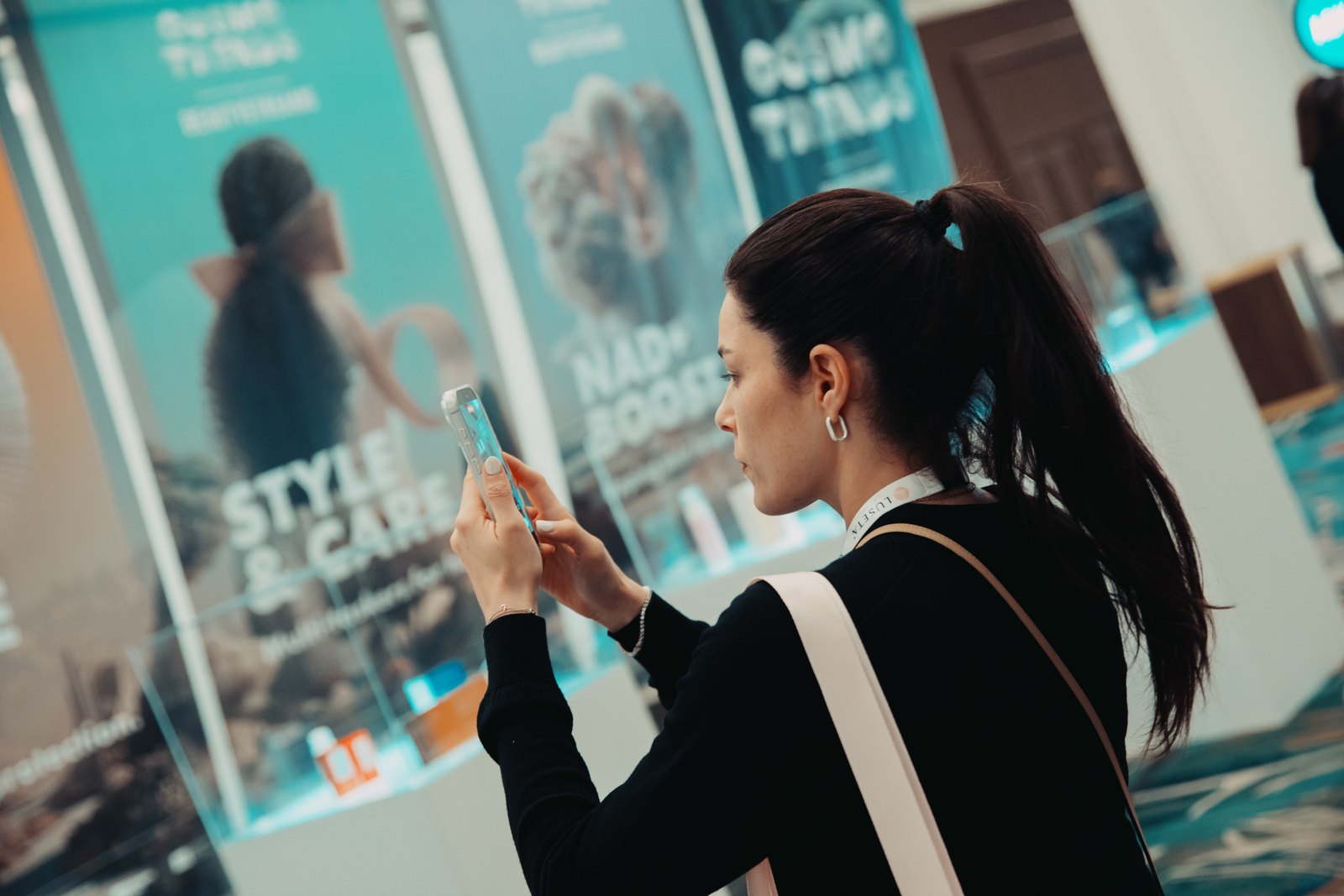
The five directions
The report's own framing this year is that style and substance got equal billing: advanced ingredients on one side, sensorial and aesthetic payoff on the other, with brands trying to deliver instant gratification in both results and feel. In practice the five split cleanly into two ingredient bets and three format bets.
NAD+ Boost, upping skin longevity. The molecule that built a supplement industry arriving in masks, serums and devices, with delivery, not the ingredient, as the unresolved problem. The report puts the market at 627.75 million dollars in 2024 heading to 2.15 billion by 2034, citing Insight Analytics.
Haute Sun, evolving UV protection. Not a filter story but a format war: sticks, serums, cushions and a dry shampoo with SPF 45+ for the scalp. Circana data in the report shows US prestige sunscreen up 11 percent in the two weeks before Memorial Day 2025 while mass sunscreen fell 2 percent.
Scalp Zoning, spotlighting the scalp. A 15.81 billion dollar category growing at 7.3 percent, formulated with skincare actives, and quietly pulled along by GLP-1 driven hair loss.
Style & Care, multi-taskers for hair. Styling products reformulated to treat while they style, which is category convergence arriving at a planogram that has not changed in twenty years.
Colla-Genius, cross-category collagen. Collagen moving into makeup and body care while the collagen itself switches from fish to yeast fermentation.
Now read the exhibitor labels
The trend names are the part everyone quotes. The part worth counting is who brought the products.
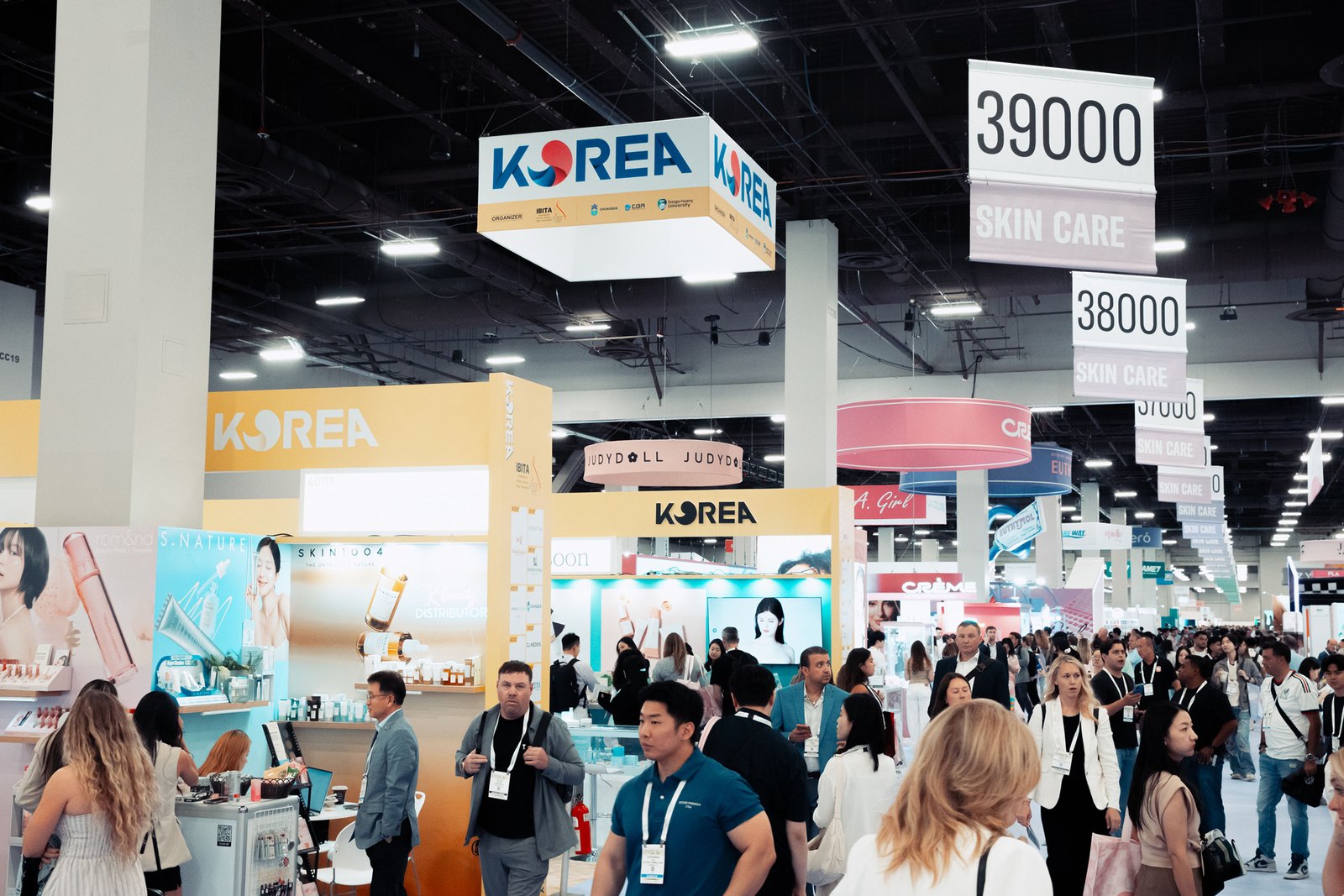
Of the twenty-three products selected across the five directions, ten came from South Korean exhibitors. Seven came from American ones. The remaining six were spread across Norway, Kuwait, Canada and China.
That distribution is the actual finding. Korea did not win a pavilion at this show, it supplied close to half of what a trend agency independently judged to be the most interesting new products in the building, across every one of the five categories: skincare, sun care, scalp, hair styling and colour. This is what we meant when we wrote from the floor that Korea has stopped being a pavilion and become the supply chain.
The American entries are worth a second look too, because they cluster: Solésence and TIMESAVVY in sun care formats, Metamorphosis in devices, K-Headspa in scalp, Pure & Cimple and Havyn in collagen. US exhibitors showed up strongest where the innovation is a format, a device or a positioning. The Korean entries dominate where the innovation is an ingredient system.
That is a division of labour, and it is not a flattering one for a domestic industry that would like to believe otherwise.
What connects the five
Strip away the naming and three things run through all of them.
The first is that the ingredient has to arrive somewhere. NAD+ needs an encapsulation system, collagen needs to be small enough to matter, exosomes need a mist that a consumer will use daily. Every serious product in those cases was really selling a delivery mechanism with an ingredient name on the front.
The second is that the benefit has to be felt immediately. A cooling scalp serum, a colour-changing mask, gold fibres that melt on application, a stick that makes reapplication plausible. None of those sensations are the mechanism, and all of them are the reason the product gets used a second time. The industry has stopped treating sensoriality as decoration and started treating it as compliance engineering.
The third is that categories are dissolving. Sunscreen is skincare. The scalp is skin. Styling is treatment. Collagen is makeup. Every one of the five trends crosses a shelf boundary that a retail buying team still uses to organize itself, which is why the interesting launches keep landing in specialty and online before they reach the aisle that should own them.
What to do with it
Treat the report as a shopping list of what can be sourced now, not as a forecast. Everything in those cases has a booth number, a manufacturer and a lead time. A private-label buyer can have a version of most of it within two seasons, which is precisely the speed problem we wrote about from the Cosmopack halls.
The next test of these five is January. Cosmoprof North America returns to Miami Beach on January 26 to 28, 2027, and to Las Vegas for its 24th edition on July 13 to 15, 2027. Retail to See will be at both. The trends that come back with distribution attached were real. The rest were a good ballroom.
If you are exhibiting at either and want to be read before the aisles fill, write to me at celia@retailtosee.com.